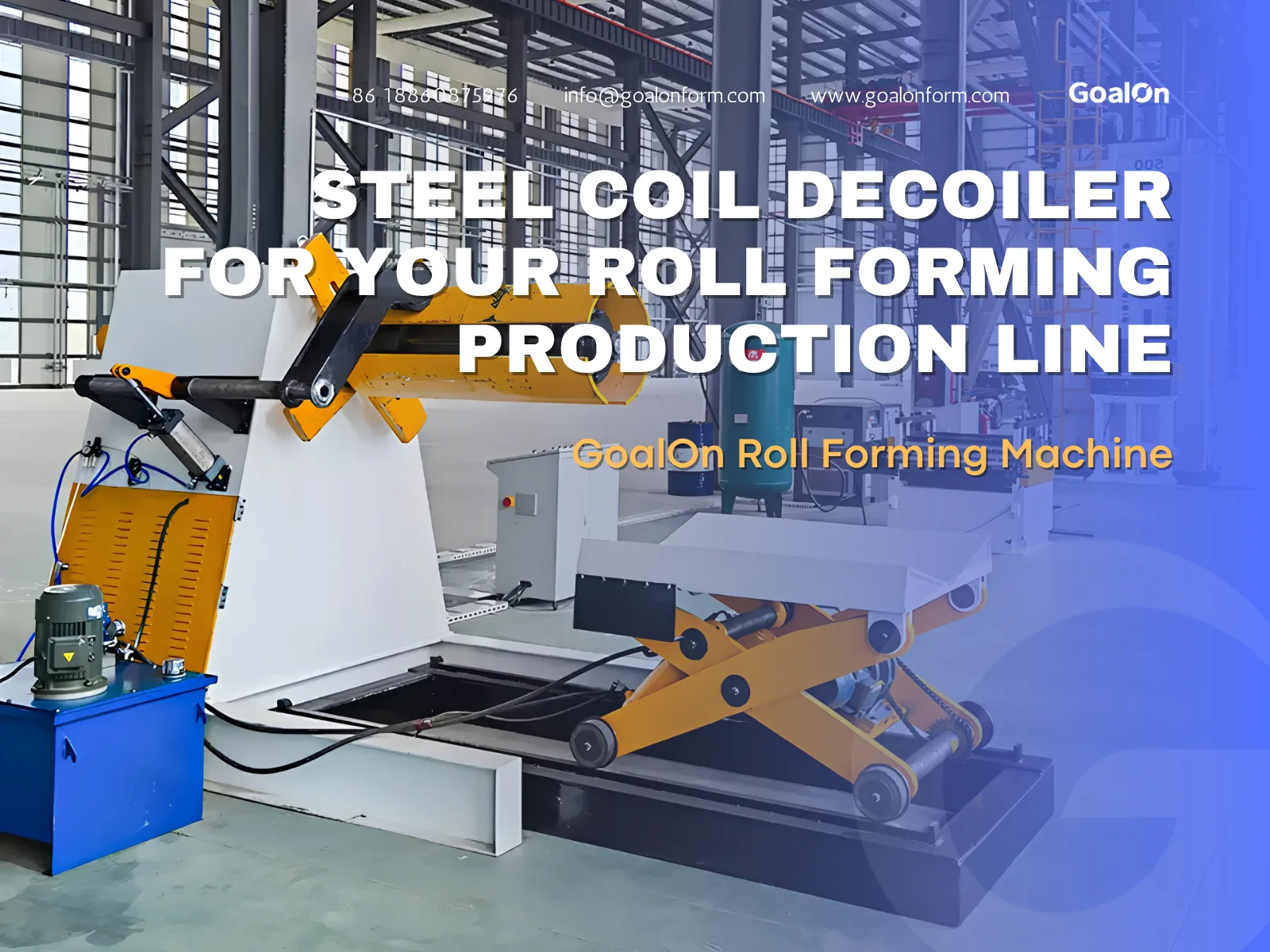
Steel Coil Decoiler: Types, Configurations and Selection Guide for Roll Forming Machines
A steel coil decoiler is an essential part of a roll forming production line. It is responsible for holding and unwinding steel coils before the material enters the leveling and forming process.
Although the decoiler is usually placed at the beginning of the production line, its performance directly affects the entire manufacturing process. A stable coil feeding system helps maintain consistent forming accuracy, reduce material waste, and improve production efficiency.
For different applications, manufacturers can choose from manual, semi-automatic, hydraulic, motorized, and fully automatic decoilers. The right configuration depends on several factors, including coil weight, material thickness, production speed, automation requirements, and available factory space.
This guide explains the main types of steel coil decoilers, their working principles, key specifications, and how to select the right steel coil handling equipment for roll forming lines.
What Is a Steel Coil Decoiler and Why Is It Important in Roll Forming Lines?
A steel coil decoiler, also called a coil uncoiler or coil unwinding machine, is equipment used to support and release steel coils in a controlled way.
Before entering a roll forming machine, steel sheets are usually supplied in coil form. The decoiler expands its mandrel inside the coil, supports the material, and rotates to provide continuous feeding.
A properly designed decoiler ensures:
- تغذية مستقرة للمواد
- Reduced manual handling
- Higher production efficiency
- Better product quality
- Safer coil loading and operation
In a complete roll forming line, the decoiler works together with other equipment, such as:
Steel Coil → Decoiler → Leveling Machine → Servo Feeder → Roll Forming Machine → Cutting System
A poor-quality decoiler can cause feeding problems, uneven material tension, coil slipping, and unnecessary production downtime.
For this reason, selecting the correct decoiler configuration is an important decision when purchasing a roll forming machine.
Main Functions of a Coil Decoiler
Although decoilers have different designs, their basic functions remain similar.
1. Supporting and Expanding Steel Coils
The decoiler uses a mandrel system to hold the inner diameter of the coil.
Common expansion methods include:
- Mechanical expansion
- Hydraulic expansion
Hydraulic expansion is often preferred for heavier coils because it provides stronger holding force and easier operation.
2. Providing Stable Material Feeding
During roll forming, the steel strip must enter the forming rollers continuously.
A high-quality decoiler helps maintain:
- Constant feeding speed
- Stable coil tension
- Smooth material movement
This is especially important when producing precision profiles such as:
- عوارض C/Z
- Metal decking
- ألواح التسقيف
- Stud and track profiles
- هياكل تركيب الطاقة الشمسية
3. Improving Production Safety
Steel coils can weigh several tons. Manual handling creates safety risks.
Modern decoilers reduce operator involvement through:
- Hydraulic coil expansion
- Motor-driven rotation
- Safety guards
- Emergency stop systems
This improves both workplace safety and production reliability.
Main Types of Steel Coil Decoilers
Steel coil decoilers can be classified according to their automation level and working method.
The most common types include:
| Decoiler Type | مستوى الأتمتة | المزايا الرئيسية | Suitable Applications |
|---|---|---|---|
| Manual Decoiler | Low | Simple structure, low cost | Small production lines |
| Semi-Automatic Decoiler | متوسط | Good balance between cost and efficiency | Medium production |
| Automatic Decoiler | مرتفع | High speed and reduced labor | Large-scale manufacturing |
| Hydraulic Decoiler | High precision | Strong coil holding ability | Heavy coils |
| Motorized Decoiler | Automated feeding | Stable speed control | الإنتاج المستمر |
Choosing the correct type depends on your production requirements rather than only the initial equipment cost.
Manual Steel Coil Decoiler
A manual steel coil decoiler is the simplest configuration available.
It normally uses a mechanical expansion system. Operators manually rotate or adjust the coil feeding process.
Advantages of Manual Decoilers
Manual decoilers are popular because they offer:
- Simple structure
- Low investment cost
- سهولة الصيانة
- Flexible operation
They are suitable for small workshops or production lines with lower output requirements.
Limitations of Manual Decoilers
However, manual models have some limitations:
- Higher labor requirements
- Slower coil replacement
- Limited production speed
- Less automatic tension control
For manufacturers producing a small number of profiles or operating at lower capacity, a manual decoiler can still be a practical choice.
Semi-Automatic Decoiler
A semi-automatic decoiler provides a balance between manual operation and full automation.
It reduces operator workload while keeping the machine structure relatively simple.
Typical features include:
- Motor-assisted rotation
- Partial automatic feeding
- Improved coil tension control
- Easier coil operation
Semi-automatic decoilers are commonly used for medium-scale production where manufacturers need better efficiency but do not require a fully automated system.
They are often selected for applications such as:
- Roof panel production
- Wall panel production
- Light gauge steel profiles
Compared with manual decoilers, semi-automatic systems can significantly improve production consistency.
Automatic Steel Coil Decoiler for High-Speed Production
An automatic steel coil decoiler is designed for manufacturers that require higher productivity, less manual operation, and better process stability.
Compared with manual and semi-automatic models, fully automatic decoilers provide more precise control of coil feeding. They are widely used in high-volume roll forming production lines where continuous operation and reduced downtime are important.
Typical features of automatic decoilers include:
- Hydraulic coil expansion
- Motor-driven coil rotation
- Automatic feeding control
- Adjustable material tension
- Integrated safety protection
For large manufacturers producing thousands of meters of profiles every day, an automatic decoiler can significantly improve production efficiency.
ومن بين الاستخدامات الشائعة ما يلي:
- C and Z purlin roll forming machines
- Metal decking roll forming machines
- Highway guardrail production lines
- Solar mounting structure production lines
- Stud and track roll forming machines
The main advantage of an automatic system is not only higher speed. It also provides more stable material feeding, which helps improve the consistency of the final profile.
Specialized Decoiler Configurations for Different Production Requirements
Besides automation levels, decoilers can also be classified according to their mechanical structure and driving method.
Different production environments require different configurations. Factors such as coil weight, material thickness, production speed, and factory layout all influence the final selection.
Hydraulic Decoiler for Roll Forming Machine
A جهاز فك اللفائف الهيدروليكي لآلة تشكيل اللفائف is designed for applications requiring stronger coil holding force and smoother operation.
Unlike mechanical expansion systems, hydraulic decoilers use hydraulic cylinders to expand and lock the mandrel inside the steel coil.
This design provides several advantages:
- Stronger coil fixing ability
- Faster coil loading
- Better operation stability
- Suitable for heavier steel coils
Hydraulic decoilers are commonly used when:
- Coil weight is high
- Material thickness is larger
- Production speed is continuous
- High feeding stability is required
For example, heavy-duty profiles such as purlins, structural components, and guardrails usually require more powerful coil handling equipment.
Main Features of Hydraulic Decoilers
| ميزة | Benefit |
|---|---|
| Hydraulic expansion mandrel | Securely holds heavy coils |
| Strong driving system | Stable rotation during production |
| Better tension control | Improves forming accuracy |
| Reduced manual adjustment | Improves operator efficiency |
For industrial roll forming lines, hydraulic decoilers are often the preferred choice because they provide better reliability under demanding production conditions.
Motorized Coil Decoiler Machine
A motorized coil decoiler machine uses an electric motor to control coil rotation.
Compared with passive decoilers, motorized models actively drive the coil, helping maintain a more stable feeding speed.
Main advantages include:
- Automatic coil rotation
- Consistent feeding speed
- Reduced operator involvement
- Better synchronization with roll forming machines
Motorized decoilers are suitable for production lines that require continuous material feeding.
They are often integrated with:
- Leveling machines
- Servo feeders
- Punching systems
- Roll forming machines
For manufacturers producing long profiles with strict dimensional requirements, stable feeding control helps reduce material deformation and improves final product quality.
Single-Arm vs Double-Arm Decoilers
The arm configuration is another important factor when selecting a steel coil decoiler.
Single-Arm Decoiler
A single-arm decoiler uses one support arm to hold the coil.
Advantages:
- Compact structure
- Requires less installation space
- Lower equipment cost
- Suitable for standard production requirements
It is commonly used in factories where floor space is limited.
Double-Arm Decoiler
A double-arm decoiler uses two coil holding stations.
Its main advantage is continuous production.
While one coil is being processed, the second coil can be prepared for replacement. This reduces downtime during coil changes.
تشمل المزايا ما يلي:
- Faster coil replacement
- Higher production continuity
- Better efficiency for mass production
Single-Arm vs Double-Arm Decoiler Comparison
| العنصر | Single-Arm Decoiler | Double-Arm Decoiler |
|---|---|---|
| Installation space | Smaller | Larger |
| Initial investment | Lower | Higher |
| Coil changing time | Longer | Shorter |
| Production continuity | Standard | Excellent |
| Suitable for | Small to medium production | الإنتاج بكميات كبيرة |
For manufacturers focused on maximum productivity, double-arm decoilers provide clear advantages.
Key Specifications to Check Before Buying a Decoiler
Selecting a decoiler should not only depend on price. The machine specifications must match your production requirements.
The following factors should be carefully evaluated.
1. Maximum Coil Weight Capacity
Coil weight is one of the most important specifications.
Common decoiler capacities include:
- 1 ton
- 3 tons
- 5 tons
- 10 tons
- Customized capacity
A decoiler with insufficient capacity may cause unstable operation and safety risks.
Always select a machine with suitable capacity based on your regular coil weight.
2. Coil Width and Thickness Range
Different roll forming applications use different steel materials.
Important parameters include:
- Maximum coil width
- Minimum and maximum material thickness
- Steel grade
- Coil inner diameter
- Coil outer diameter
على سبيل المثال:
- Light gauge profiles may use thinner galvanized steel.
- Structural purlins usually require thicker steel coils.
The decoiler must match the material specifications of the roll forming machine.
3. Expansion System
The expansion method affects operation convenience and coil stability.
(1) Mechanical Expansion
Advantages:
- Simple structure
- Lower cost
- سهولة الصيانة
Suitable for:
- Light coils
- Small production lines
(2) Hydraulic Expansion
Advantages:
- Strong holding force
- Faster operation
- Better for heavy coils
Suitable for:
- High-speed production
- Industrial applications
4. مستوى الأتمتة
The required automation level depends on production volume.
Consider:
- How many hours the line runs daily
- Number of operators available
- Required production speed
- Future expansion plans
For small workshops, a manual or semi-automatic decoiler may be enough.
For large manufacturers, an automatic steel coil decoiler can provide better long-term value.
Steel Coil Handling Equipment for Roll Forming Line Integration
A decoiler is only one part of a complete coil processing system.
Modern production lines usually combine multiple machines to create a continuous workflow.
يتضمن التكوين النموذجي ما يلي:
Steel Coil → Decoiler → Leveling Machine → Servo Feeder → Roll Forming Machine → Cutting System
The complete steel coil handling equipment for roll forming line helps manufacturers achieve:
- سرعة إنتاج أعلى
- Better material accuracy
- Reduced waste
- انخفاض متطلبات العمالة
Proper integration between the decoiler and roll forming machine is essential.
For example, if the decoiler cannot provide stable feeding, even a high-precision roll forming machine may not achieve the expected profile quality.
Safety and Maintenance Tips for Long-Term Decoiler Performance
Proper operation and maintenance can extend the service life of a decoiler.
Safety Practices
Operators should:
- Confirm coil weight before loading
- Check coil positioning
- Keep hands away from moving parts
- Use emergency stop functions correctly
Maintenance Practices
Regular maintenance should include:
- Checking hydraulic oil condition
- Inspecting bearings
- Lubricating moving parts
- Checking electrical connections
- Inspecting expansion components
A well-maintained decoiler reduces unexpected downtime and improves production reliability.
How to Choose a Decoiler for Roll Forming Machine
Choosing the right decoiler is an important step when planning a roll forming production line.
The best configuration depends on your actual production requirements, not simply the machine price.
Before selecting a decoiler, consider the following factors:
1. Material Specifications
First, confirm the steel coil information:
- نوع المادة
- Coil thickness
- عرض الملف
- Coil weight
- Coil inner diameter
- Coil outer diameter
Different materials require different levels of coil support and tension control.
على سبيل المثال:
- Thin galvanized steel requires stable feeding to prevent deformation.
- Thick structural steel requires stronger coil holding force.
2. Production Speed and Output Requirements
Production volume directly affects the required automation level.
For low-volume production:
- Manual decoilers may be sufficient.
- Semi-automatic models can improve efficiency.
For continuous industrial production:
- Automatic decoilers are usually a better choice.
- Double-arm configurations can reduce coil change downtime.
A higher level of automation can reduce labor dependence and improve long-term productivity.
3. Roll Forming Machine Compatibility
The decoiler must match the complete production line.
Important considerations include:
- Feeding speed
- Material thickness range
- Control system compatibility
- Installation space
- Communication between machines
A properly matched decoiler helps the roll forming machine operate more smoothly.
4. Factory Space and Layout
The available installation area also affects the selection.
Consider:
- Machine footprint
- Coil loading direction
- Operator working area
- Material storage space
A compact single-arm decoiler may be suitable for factories with limited space, while a double-arm decoiler is better for large-scale production environments.
5. Future Production Expansion
When investing in equipment, consider future growth.
A machine that only meets current requirements may limit future production.
Manufacturers should consider:
- Possible increase in production volume
- New product sizes
- Additional roll forming lines
- Higher automation requirements
Choosing a suitable decoiler from the beginning can reduce future upgrade costs.
Common Applications of Steel Coil Decoilers
Steel coil decoilers are widely used in many metal forming industries.
تشمل التطبيقات النموذجية ما يلي:
Purlin Roll Forming Lines
For producing:
- عوارض C
- Z purlins
- U channels
These applications often require hydraulic or motorized decoilers because structural profiles usually use heavier steel coils.
Roofing and Wall Panel Production Lines
Used for:
- Trapezoidal roof panels
- Corrugated panels
- Standing seam panels
These applications usually focus on smooth feeding and surface protection because appearance quality is important.
Metal Decking Production Lines
Metal decking machines often require stable coil feeding because the profile shape and embossing process demand high consistency.
Stud and Track Roll Forming Lines
Light gauge steel profiles require accurate feeding control to maintain dimensional accuracy.
Solar Mounting Structure Production Lines
Solar profiles often use galvanized steel or aluminum-zinc coated steel.
Stable decoiling helps ensure:
- Accurate hole positioning
- Consistent profile dimensions
- تقليل نفايات المواد
Future Trends in Steel Coil Decoiler Technology
The steel processing industry is moving toward higher automation, smarter control, and improved energy efficiency.
Future steel coil decoilers will continue to develop in several directions.
Smart Automation
Modern factories increasingly require equipment that can communicate with production systems.
Future decoilers may include:
- Automatic coil detection
- Digital monitoring
- التشخيص عن بُعد
- Production data tracking
These functions help manufacturers improve efficiency and reduce downtime.
Higher Energy Efficiency
Energy-saving designs are becoming increasingly important.
Manufacturers are focusing on:
- More efficient motors
- Improved hydraulic systems
- Reduced idle energy consumption
Lower energy usage helps reduce operating costs.
Improved Safety Systems
Safety will remain a major focus.
Future decoilers may include:
- Advanced sensors
- Automatic protection systems
- Intelligent safety monitoring
These technologies help create safer working environments.
Why Choosing the Right Decoiler Matters for Your Roll Forming Business
A decoiler is not only a coil unwinding device. It is an important part of the entire roll forming production system.
The right configuration can help manufacturers achieve:
- More stable production
- Better profile quality
- Lower material waste
- Reduced downtime
- Improved operator safety
When selecting a decoiler, companies should evaluate the complete production requirement, including coil specifications, output targets, automation needs, and future expansion plans.
Conclusion: Select the Right Steel Coil Decoiler for Better Production Efficiency
Choosing the correct steel coil decoiler is essential for building an efficient and reliable roll forming line.
Manual, semi-automatic, hydraulic, motorized, and fully automatic decoilers each have their own advantages. The ideal choice depends on your coil size, production volume, profile requirements, and automation goals.
For manufacturers investing in roll forming equipment, the decoiler should be considered as an important part of the complete solution rather than a simple accessory.
A properly selected decoiler improves material handling, increases production stability, and helps achieve better long-term return on investment.
If you are planning a new roll forming production line or upgrading your existing coil handling system, choosing the right decoiler configuration is the first step toward more efficient metal profile manufacturing.