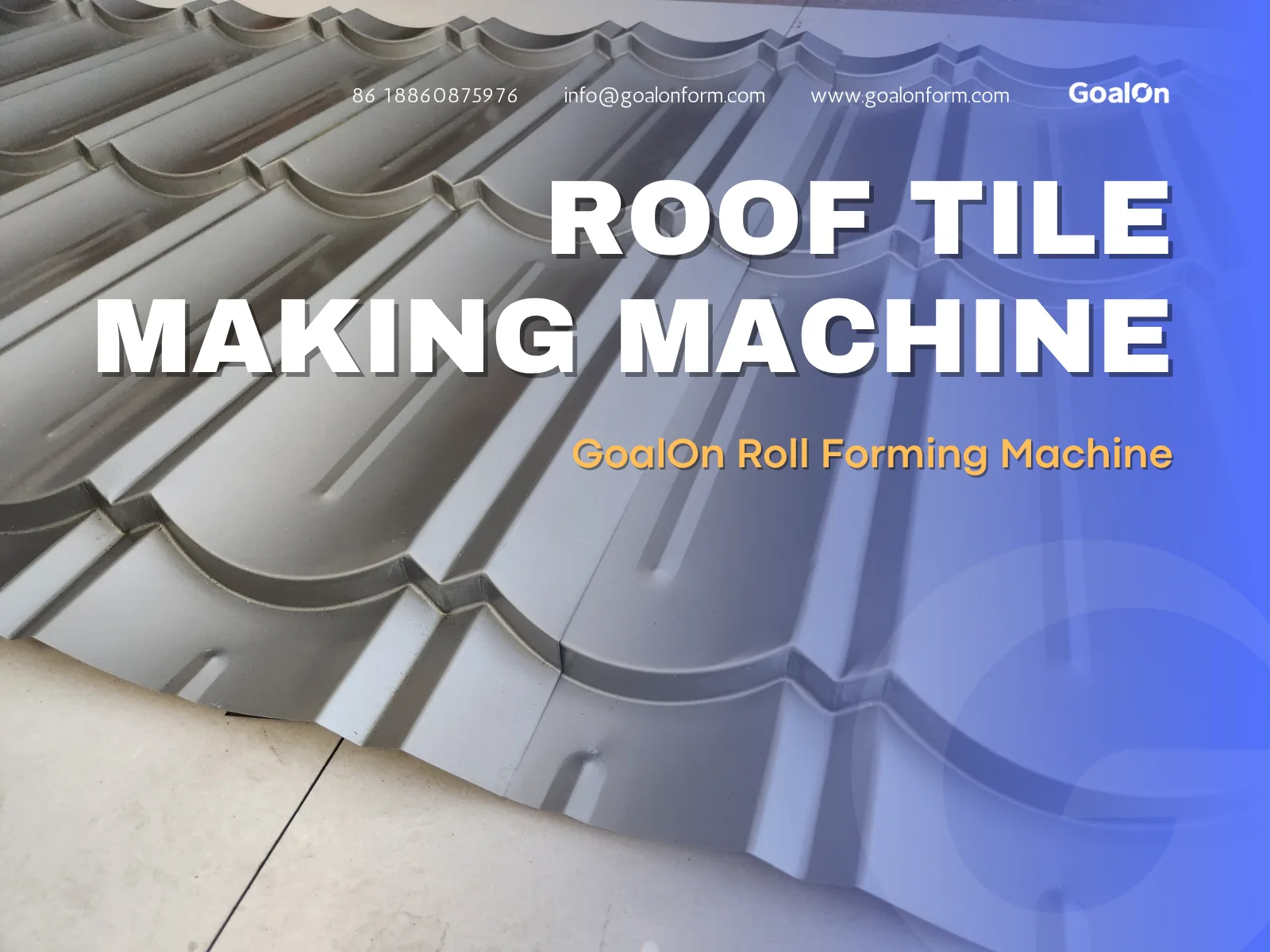
A roof tile roll forming machine is an automated production line designed to manufacture metal roof tiles from steel coils. It continuously performs feeding, roll forming, pressing, and cutting to produce uniform roofing panels with high efficiency, consistent quality, and precise dimensions. The line is widely used for residential, commercial, and industrial roofing projects.
Popular Roof Tile Profiles and Standard Sizes
Metal roof tiles are available in profiles such as glazed tile, Spanish tile, Roman tile, and step tile. They are commonly produced from PPGI, galvanized steel (GI), Galvalume, or aluminum, with typical thicknesses of 0.3–0.8 mm. Standard widths and lengths vary by market and project requirements.
Different profiles serve different applications. Residential buildings often prefer glazed or Spanish-style tiles for their appearance, while commercial and agricultural projects focus on strength, weather resistance, and fast installation. For both current production and future demand, a roof tile roll forming machine remains the most efficient manufacturing solution, delivering high output, consistent dimensions, low material waste, and stable product quality.
Suitable Materials for Roof Tile Manufacturing
A roof tile roll forming machine is commonly used to process:
- PPGI (Pre-painted Galvanized Steel) – popular for colorful and decorative roof tiles
- GI (Galvanized Steel) – provides good corrosion resistance
- Galvalume Steel – offers better durability for harsh environments
- الألومنيوم – lightweight and suitable for special roofing applications
The typical material thickness is 0.3–0.8 mm, depending on the roof tile profile and project requirements.
What Is a Roof Tile Roll Forming Machine?
A roof tile roll forming machine is an automated production line that converts metal coils into finished roof tiles. A standard roof tile production line typically includes decoiling → roll forming → tile pressing → hydraulic cutting → run-out table, ensuring continuous production, accurate dimensions, and stable quality.
To meet higher production and product requirements, the line can be upgraded with lamination, inkjet coding, or enhanced forming and cutting systems. These options improve efficiency, expand product functions, and help manufacturers produce metal roof tiles for different markets with greater flexibility and lower operating costs.
How Does a Roof Tile Production Line Work?
A roof tile making machine works by gradually shaping a metal coil through multiple forming stations. The decoiler feeds the coil into the machine, and precision-designed rollers apply controlled bending force step by step to create the required roof tile profile without damaging the material.
After forming, the tile pattern is pressed, and the system performs accurate hydraulic cutting according to the preset length. This continuous process ensures high production speed, stable quality, and consistent dimensions for metal roof tile manufacturing.
Who Uses a Roof Tile Making Machine?
A roof tile making machine is mainly used by businesses that need continuous production of metal roofing panels. It is suitable for manufacturers, construction suppliers, and steel processing companies that want to produce customized roof tiles with stable quality and high efficiency.
| Customer Type | Typical Applications |
|---|---|
| Roofing manufacturers | Mass production of metal roof tiles for residential and commercial buildings |
| Steel service centers | Processing steel coils into finished roofing products |
| Construction material suppliers | Expanding product lines with locally produced roof panels |
| Building contractors & developers | Producing roofing materials for large-scale projects |
These machines are widely used in residential roofing, industrial buildings, warehouses, agricultural structures, and prefabricated construction projects.
Common Roof Tile Roll Forming Machine Configurations
A roof tile roll forming production line can be customized according to production speed, material thickness, labor cost, and product requirements. Different configurations directly affect production efficiency, automation level, and final product quality.
1. Decoiler Options
The decoiler feeds the steel coil into the forming system. The right choice depends on coil weight, production speed, and automation requirements.
| النوع | Features | Suitable For |
|---|---|---|
| Manual / Non-powered Decoiler | Simple structure, low investment, requires manual coil loading | Small production volume |
| Hydraulic Decoiler | Automatic expansion and hydraulic rotation improve safety and efficiency | Medium and high-volume production |
| Hydraulic Decoiler with Coil Car | Easier coil loading, reduces labor effort, suitable for heavy coils | Large coils and continuous production |
2. Roll Forming Machine Options
The forming section is the core of the automatic metal roof tile production line. Different structures are selected based on speed, profile quantity, and production capacity.
| النوع | Features | Recommended For |
|---|---|---|
| Standard Single Layer Roll Former | Reliable design with lower investment | Standard roof tile production |
| High-Speed Frame-Type Roll Former | Stronger machine structure, higher forming speed, better stability | Large-scale production |
| Double / Triple Layer Roll Former | One machine can produce multiple profiles by switching layers | Customers requiring different roof tile models |
3. Cutting System Options
The cutting system determines production speed and finished product accuracy.
| النوع | Features | المزايا |
|---|---|---|
| Stop-and-Cut System | Machine stops before cutting | Simple structure and cost-effective |
| Flying / Tracking Cut System | Cutting unit moves together with the profile | Higher speed and continuous production |
For customers with high output requirements, tracking cutting technology helps reduce downtime and improve production efficiency.
4. Run-out Table and Stacking System
After cutting, finished roof tiles need to be collected and transferred efficiently.
| النوع | Features | Suitable For |
|---|---|---|
| Non-powered Out Table | Simple support table for manual collection | Small and medium production |
| Automatic Stacker | Automatically collects and stacks finished roof tiles | High-volume production with reduced labor |
Choosing the right configuration allows manufacturers to balance investment cost, production capacity, and automation level while building a suitable roof tile roll forming machine for their market.
How to Choose the Right Roof Tile Production Line?
Choosing the right automatic roof tile machine depends on more than the machine price. Customers should consider their business model, production targets, product requirements, and future expansion plans. A suitable configuration can help reduce operating costs and improve long-term profitability.
1. Choose Based on Your Business Type
Different customers have different production goals. The required machine configuration may vary significantly.
| Customer Type | Main Purpose | Recommended Focus |
|---|---|---|
| Roof tile manufacturers / profile suppliers | Produce metal roof tiles for sale | Higher speed, stable production, automatic stacking, multiple profiles |
| Roofing contractors / construction companies | Produce roofing panels for their own projects | Flexible production, suitable profile range, easy operation |
| Machine distributors / investors | Sell machines or build local production capacity | Popular profiles, reliable configuration, easy maintenance |
2. Choose Based on Production Capacity
Production volume directly affects machine structure and automation level.
- Small production demand: Standard roll forming machine with manual loading and out table can reduce initial investment.
- Medium production demand: Hydraulic decoiler and improved cutting systems increase efficiency.
- Large-scale production: High-speed roll former, flying cut, and automatic stacker help achieve continuous production with lower labor costs.
3. Choose Based on Roof Tile Profiles and Materials
Before ordering a metal roof tile machine, customers should confirm:
- Required roof tile profile and drawing
- Steel coil material, such as PPGI, GI, Galvalume, or aluminum
- Material thickness, usually 0.3–0.8 mm
- Required tile length and tolerance
Different profiles require different roller designs and forming solutions.
4. Consider Future Expansion
A machine should not only meet current needs but also support future growth.
Customers who plan to expand product categories can consider:
- Double-layer or triple-layer roll forming machines for multiple profiles
- Automatic stacking systems for labor reduction
- Additional functions such as lamination or inkjet coding
A professional roof tile production line manufacturer can help customers balance investment, production efficiency, and future development requirements.
Factors That Affect Roof Tile Production Line Price
The price of a roof tile making machine depends on many factors, not only the machine size. Different production requirements, automation levels, and component selections can significantly affect the final investment. Understanding these factors helps customers choose a cost-effective roof tile production line.
1. Machine Configuration and Automation Level
Automation is one of the main factors affecting the roof tile roll forming machine price. A basic configuration is suitable for small production, while advanced systems improve efficiency and reduce labor costs.
| Configuration | Price Impact | Suitable For |
|---|---|---|
| Manual decoiler + standard cutting | Lower investment | Small production volume |
| Hydraulic decoiler + improved cutting | Medium investment | Regular commercial production |
| Flying cut + automatic stacker | زيادة الاستثمار | High-speed and large-scale production |
2. Roof Tile Profile and Production Requirements
Different metal roof tile profiles require different roller designs, forming stations, and machine structures.
Factors include:
- مدى تعقيد الملف الشخصي – More complex tile shapes may require more forming stations.
- سُمك المادة – Thicker materials need stronger rollers and shafts.
- سرعة الإنتاج – Higher output requires stronger machine structures and faster systems.
- Number of profiles – Multiple products may require double-layer or triple-layer solutions.
3. Key Component Selection
The quality of components directly affects machine performance, service life, and maintenance cost.
ومن بين العوامل المهمة ما يلي:
| Component | Influence on Price |
|---|---|
| Rollers | Material quality and machining accuracy affect forming stability |
| Shafts and bearings | Higher strength components improve durability |
| Electrical system | Brands such as Siemens, Schneider, or equivalent options affect reliability |
| Hydraulic system | Affects cutting performance and long-term operation |
4. Additional Functions and Customization
Customers may add optional systems according to market needs:
- Lamination system for protective film application
- Inkjet coding system for product identification
- Automatic stacking system to reduce manual handling
- Customized voltage, layout, and safety standards for different countries
A professional roof tile making machine manufacturer should help customers balance initial investment, production efficiency, and long-term operating cost, instead of simply choosing the lowest machine price.
Why Choose Goalon Machinery for Your Roof Tile Roll Forming Machine?
Choosing the best roof tile roll forming machine manufacturer is not only about the initial machine price. Long-term production stability, technical support, maintenance cost, and finished product quality are also important factors. Compared with low-cost suppliers, Goalon Machinery focuses on providing reliable machines that help customers produce high-quality metal roof tiles with consistent performance.
| Comparison Item | ماكينات جولان | Company A | Company B |
|---|---|---|---|
| Price Range | Competitive price with customized solutions | Lower initial price, limited options | Higher price with standard packages |
| Forming Speed | 10–15 m/min (customizable according to profile) | 6–10 m/min | 8–12 m/min |
| Warranty | 1 year standard warranty + lifetime technical support | 6 months warranty | 1 year warranty |
| Lead Time | 60–90 working days depending on configuration | 90–120 days | 90 days |
| Software Support | PLC programming adjustment and remote support | Basic operation support | Limited remote support |
| On-site Service | Engineer installation and commissioning available | Limited service | Available with additional cost |
| مادة الأسطوانة | GCr15 high-quality bearing steel rollers with precision machining | 40Cr rollers | Standard alloy rollers |
| Roller Change Time | Optimized design for faster profile change | Longer adjustment time | Medium change time |
| Technical Training | Operation, maintenance, and troubleshooting training | Basic operation training | Operation training only |
| Spare Parts Supply | Recommended spare parts list and long-term supply | Limited stock | Available but higher cost |
The right machine supplier should provide more than equipment. Stable forming performance, accurate technical support, and long-term service capability are the key factors that protect your investment.
Producing High-Quality Roof Tiles Is the Final Goal
For customers, the quality of the finished metal roof tile is often more important than the machine itself. A good roof tile should have:
- Accurate dimensions to ensure easy installation
- Smooth surface without scratches or deformation
- Consistent tile shape from the first piece to the last piece
- Clean cutting edges without obvious burrs
- Stable strength and good appearance after forming
With precise roller design, stable machine structure, and professional commissioning support, Goalon Machinery’s roof tile roll forming machines help manufacturers produce high-quality roofing products that meet different market requirements.