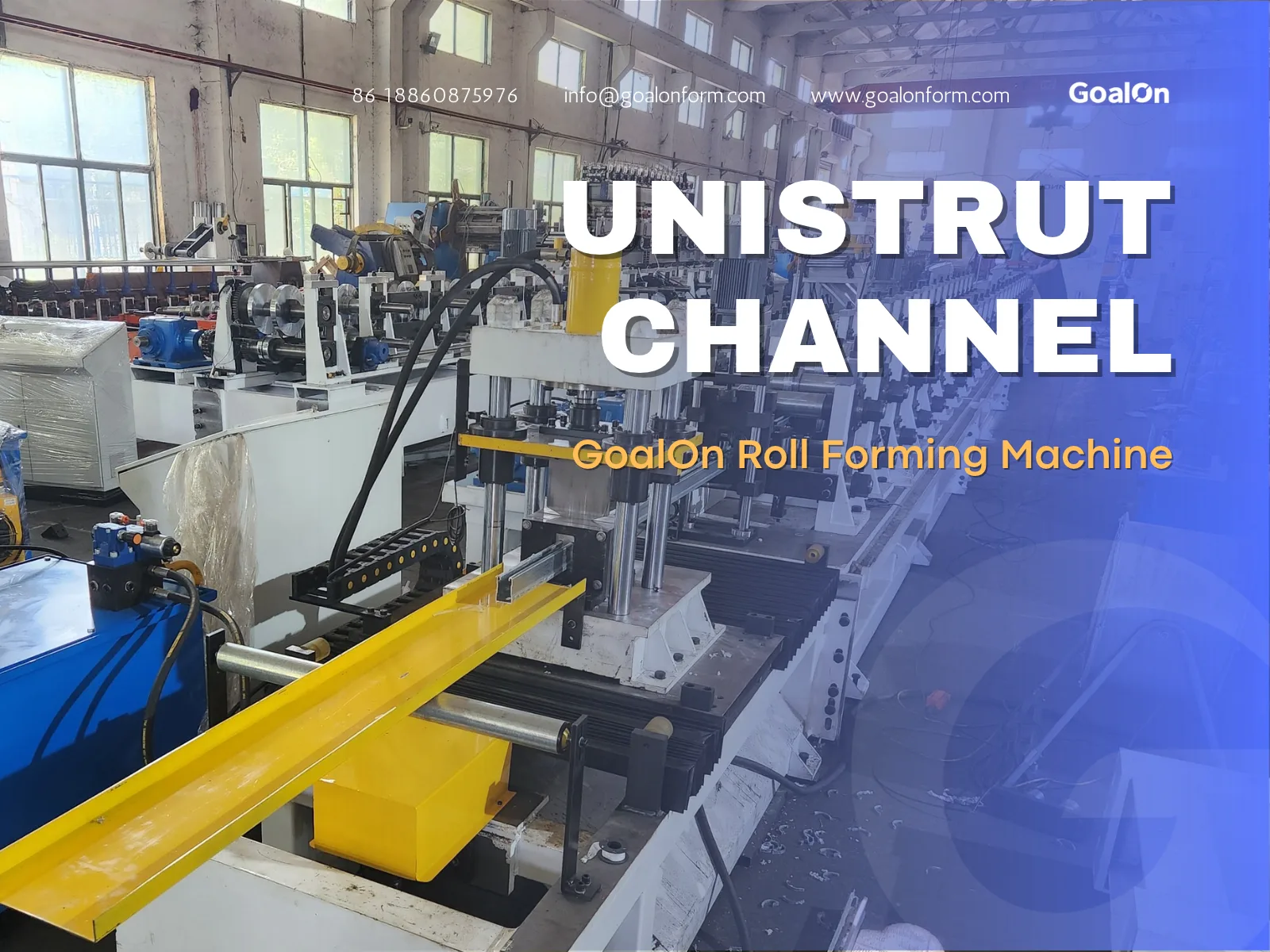
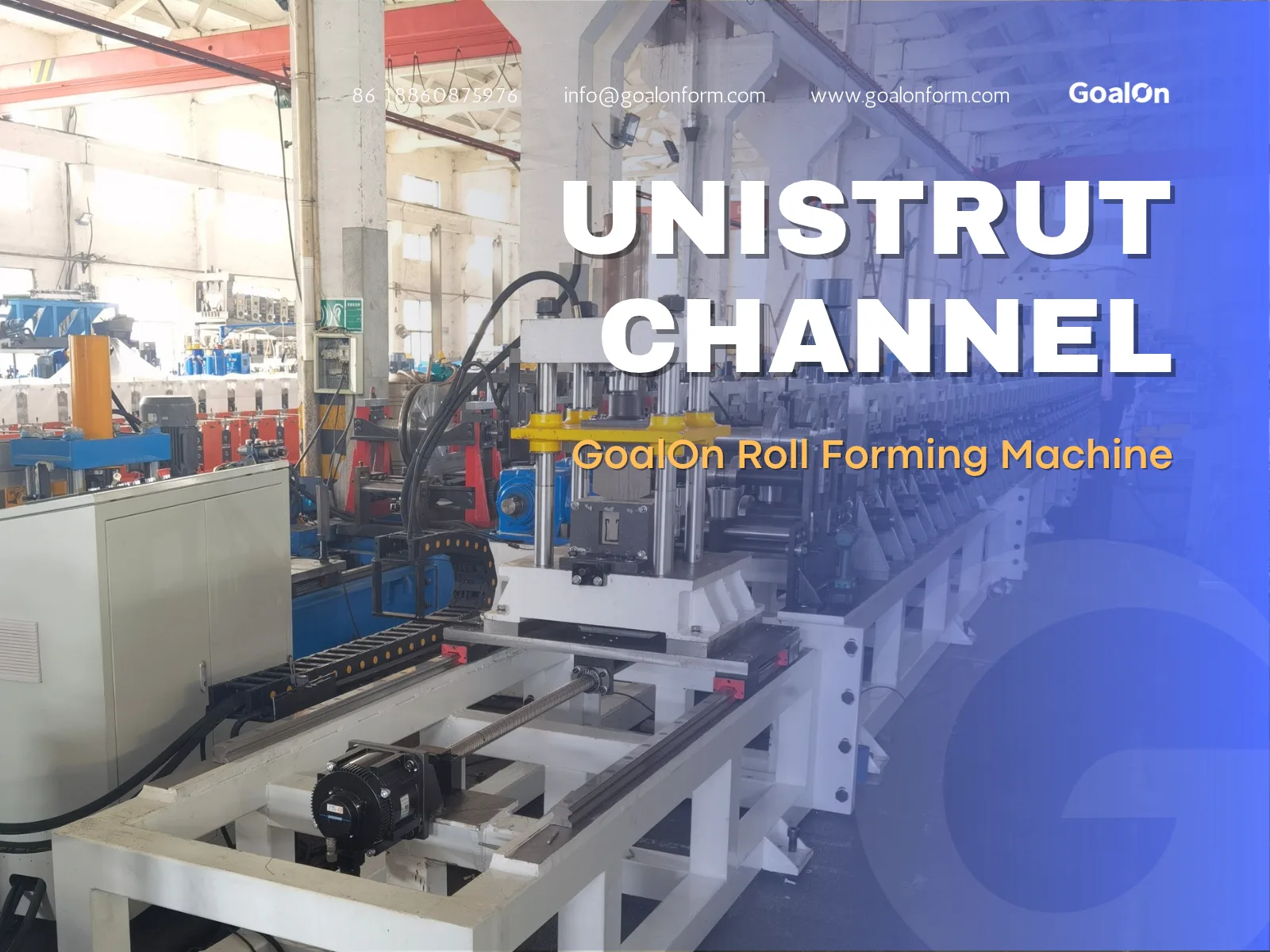
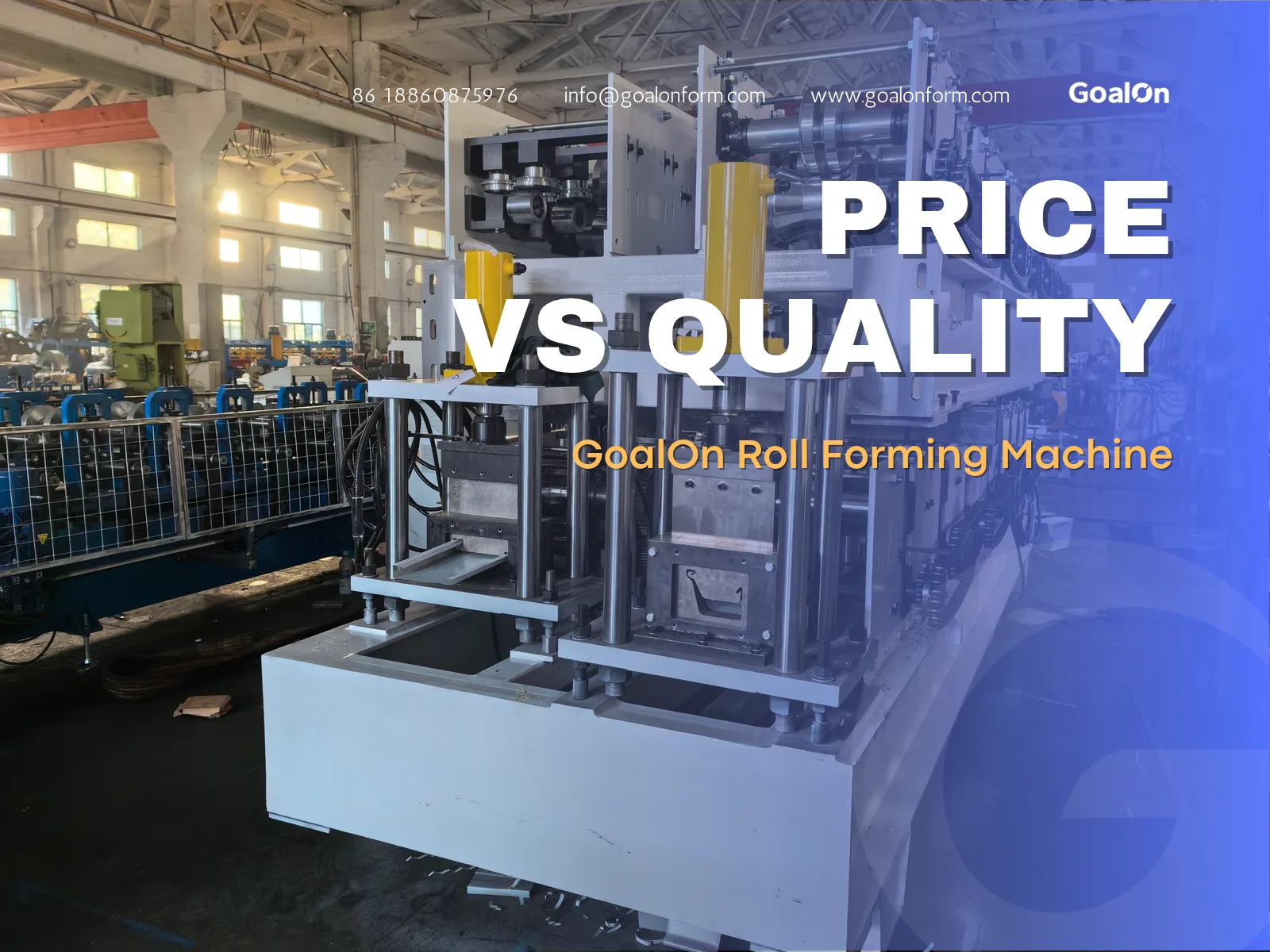
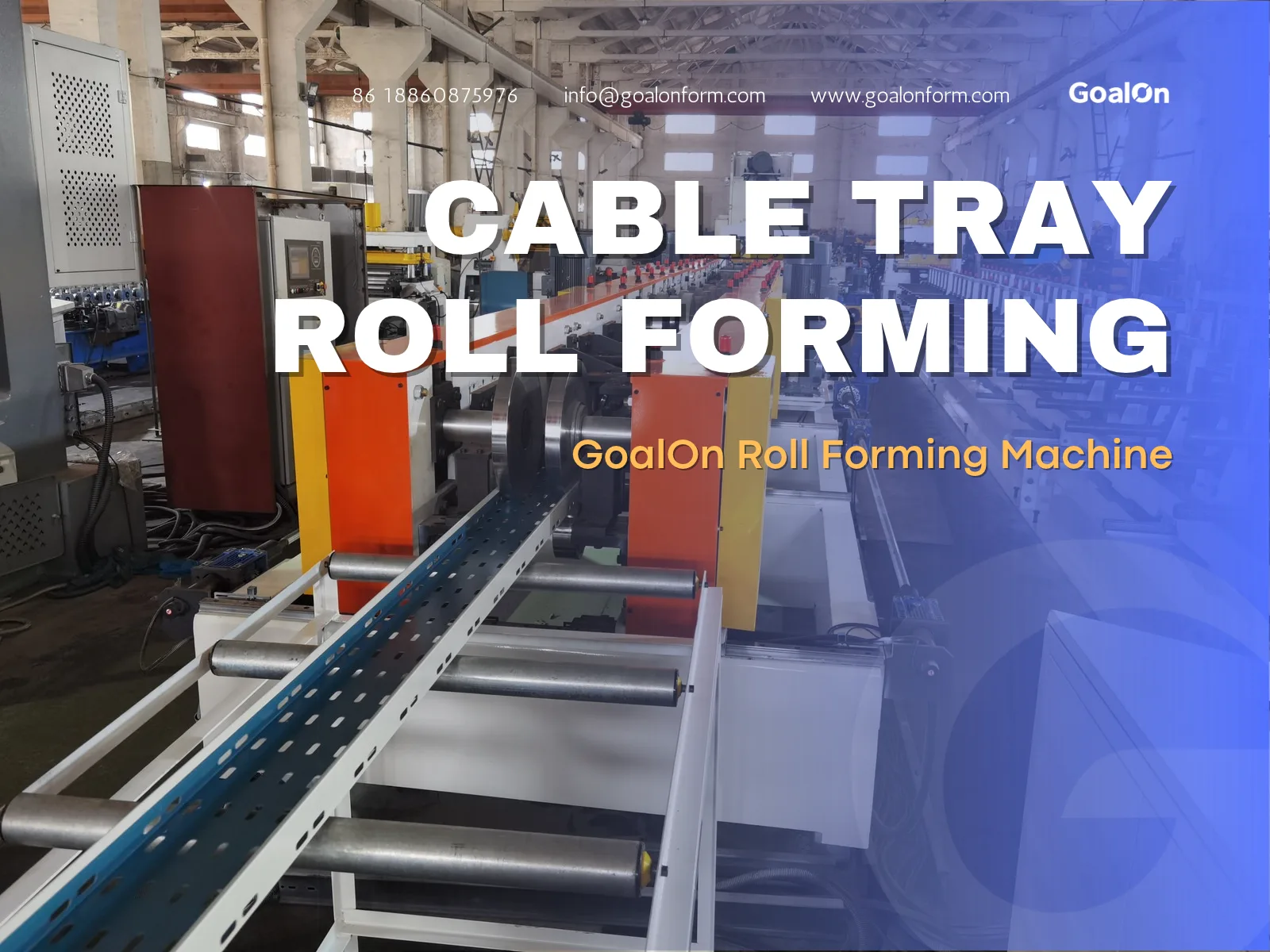
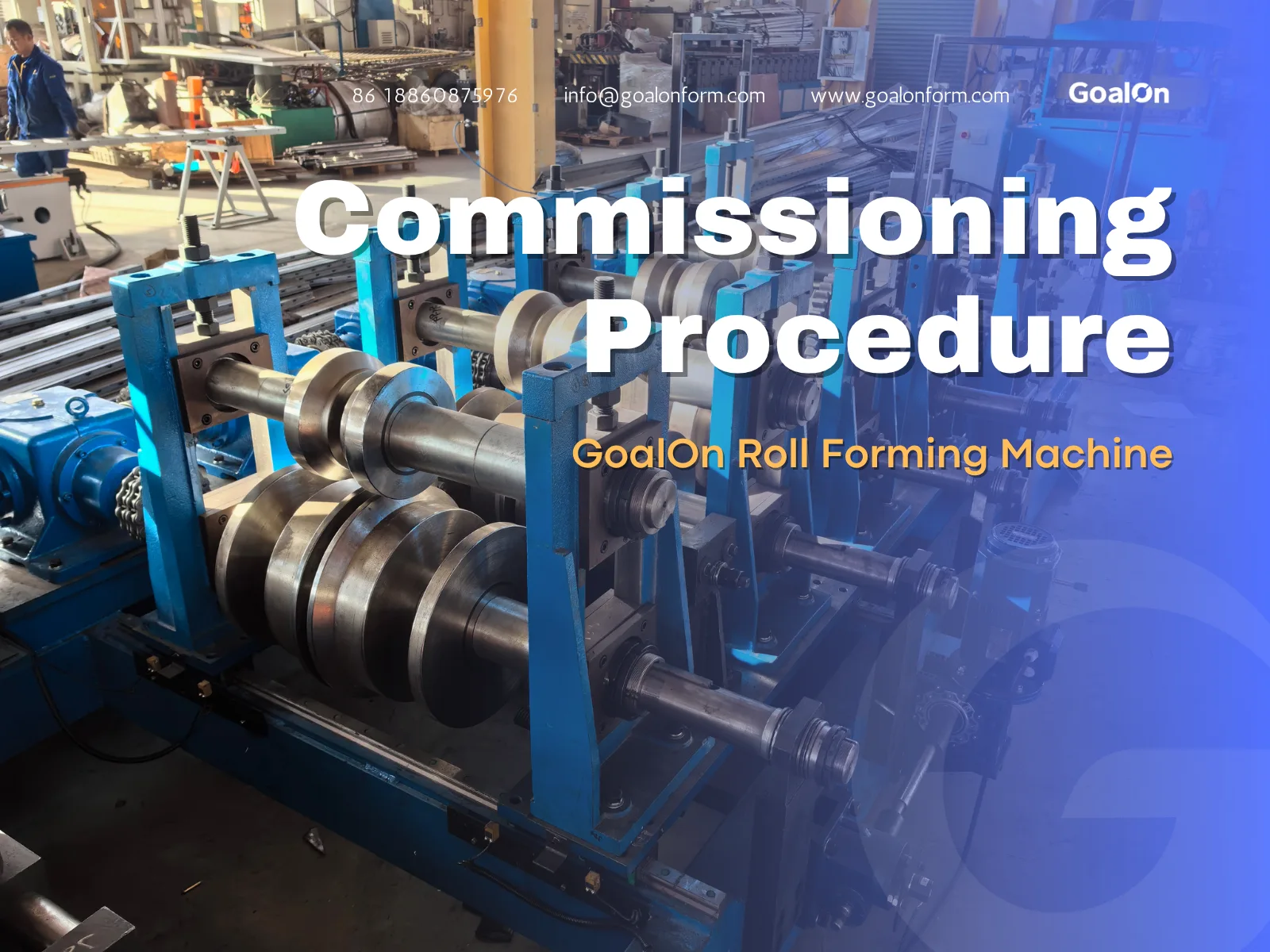
Punching is a critical process in strut channel manufacturing. It determines the position, shape, and spacing of holes used for connecting brackets, bolts, and other installation components. When designing a Strut Channel Roll Forming Line, one important decision is whether to punch the steel strip before or after roll forming.
Strut Channel Pre-Punching and post-punching use different production sequences, tooling arrangements, and positioning methods. Each has advantages and limitations. The right choice depends on the channel profile, hole pattern, material thickness, required accuracy, production speed, and investment budget.
In this guide, we compare both methods from an engineering and production perspective. We also explain how to select a suitable Strut Channel Punching Machine for your manufacturing requirements.
1. What Are Pre-Punching and Post-Punching?
In a roll forming production line, punching creates holes or slots in a metal strip or finished profile. These features may include round holes, elongated slots, mounting openings, and special connection patterns.
The main difference between the two methods is the position of the punching operation in the production sequence.
1.1 What Is Pre-Punching?
Pre-punching means creating holes in the flat steel strip before it enters the roll forming section.
A typical production sequence is:
Decoiling → Leveling → Servo Feeding → Pre-Punching → Roll Forming → Cutting
The flat strip passes through a punching station. A hydraulic press and customized punching dies create the required holes according to the product drawing.
The punched strip then enters the roll forming machine, where multiple roller stations gradually form it into the required channel profile.
Because the material is flat during punching, the dies have direct access to the punching area. This makes tool design, installation, and maintenance relatively straightforward.
1.2 What Is Post-Punching?
Post-punching means creating holes after the strip has passed through the roll forming section.
A typical sequence is:
Decoiling → Leveling → Roll Forming → Post-Punching → Cutting
The metal strip is first formed into the required channel shape. The punching unit then creates holes on the formed profile.
The punching tools must match the final cross-section. Depending on the channel design, the system may require customized upper and lower dies, profile supports, and accurate positioning devices.
Post-punching is useful when hole locations need to reference the finished profile or when forming could change the shape or position of pre-punched features.


2. Pre-Punching: Advantages, Limitations, and Applications
Pre-punching is widely used in roll forming lines because it provides easy access to the flat material and allows relatively simple die construction.
However, punching accuracy before forming does not automatically guarantee the same hole position on the finished channel. The downstream forming process must also be considered.
2.1 Advantages of Pre-Punching
1. Easier Die Design and Maintenance
The flat strip provides open access to the punching area. Punches and dies can be arranged without matching a complex finished channel shape.
This generally reduces tooling complexity and makes routine maintenance easier.
2. Flexible Hole Patterns
Pre-punching can handle different combinations of round holes, elongated slots, and other openings. The die can be customized according to the customer’s product drawing.
For manufacturers producing several hole patterns, a suitable die arrangement can provide good production flexibility.
3. Suitable for Repetitive Production
When the hole pattern is standardized, an automatic feeding and punching system can produce repeated features before the strip enters the forming section.
This arrangement works well for many conventional slotted strut channels.
4. Easier Tool Access
Operators can inspect, clean, and replace punches and dies more conveniently because the material is still flat.
2.2 Limitations of Pre-Punching
The main engineering challenge is the change in material geometry during roll forming.
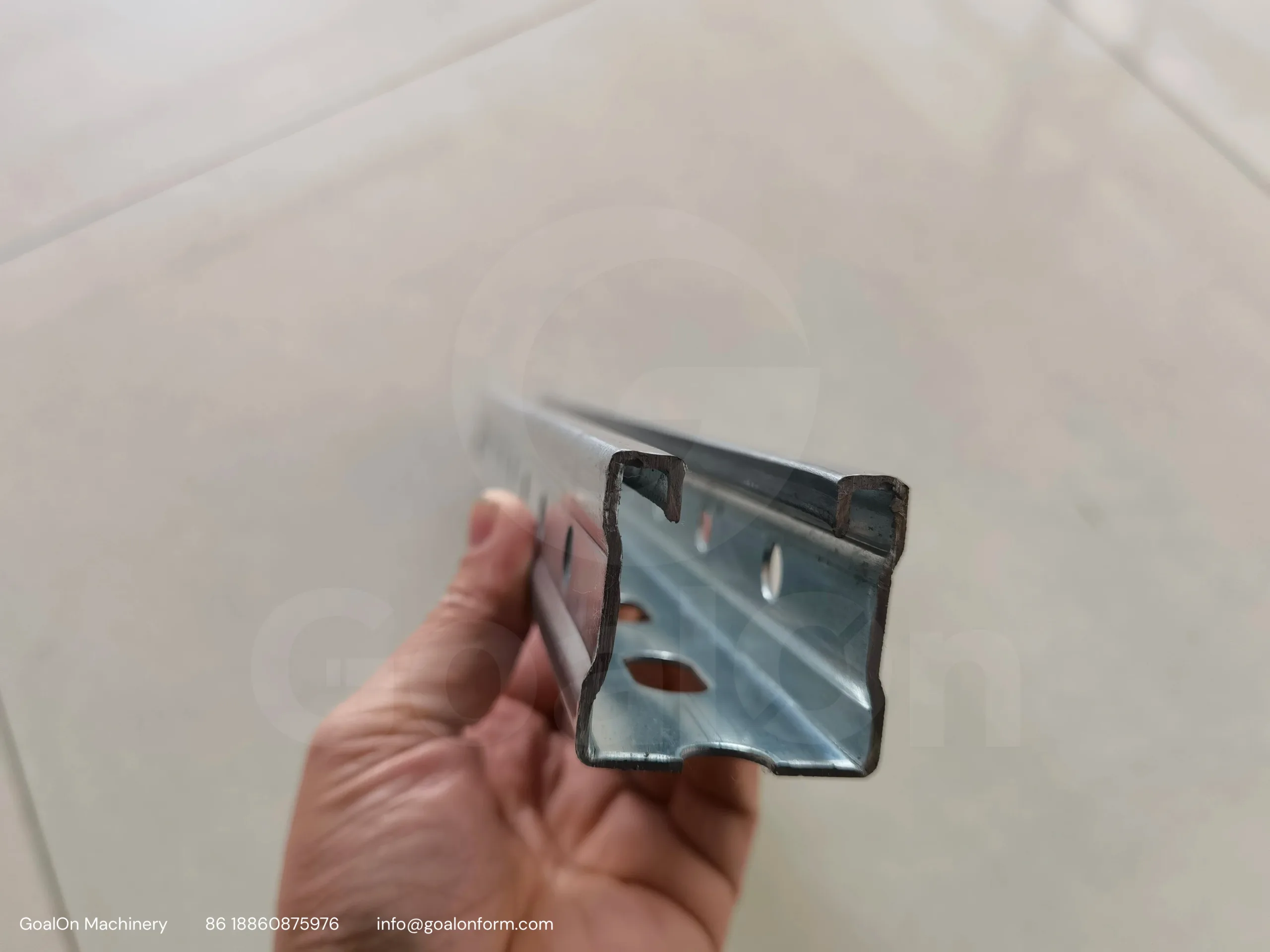
When a flat strip passes through multiple roller stations, different areas experience bending and material elongation. If a hole is located close to a bend line, its shape or final position may change.
Common issues include:
- Hole distortion near forming corners.
- Changes in hole spacing after forming.
- Position deviation caused by material feeding errors.
- Differences between flat-strip measurements and finished-profile measurements.
For example, a slot punched near the transition between the web and sidewall may be affected by subsequent bending. A hole located in the center of a relatively flat web is generally less exposed to this type of deformation.
Therefore, hole location should be checked against the complete forming sequence before finalizing the punching die.
2.3 When Is Pre-Punching Suitable?
Pre-punching is often a good choice when:
- The hole pattern is repetitive and standardized.
- Most holes are located on flat areas of the finished profile.
- The product requires multiple hole shapes.
- Easy die maintenance is important.
- The production line uses stable servo feeding.
- Tooling cost and production flexibility are key considerations.
For many standard slotted strut channels, pre-punching is a practical and economical solution.
3. Post-Punching: Advantages, Limitations, and Applications
Post-punching performs the punching operation after the channel has reached its required cross-section.
This method changes the relationship between the punching die and the finished product. Instead of punching a flat strip, the tooling must work with the formed channel.
3.1 Advantages of Post-Punching
1. Hole Position Can Reference the Finished Profile
Post-punching allows the hole location to be established according to the formed channel geometry.
This can be useful when the hole position must be controlled relative to a finished edge, lip, or other formed feature.
It also avoids exposing the punched hole to all downstream forming operations.
2. Reduced Risk of Forming-Related Hole Distortion
Because the punching operation takes place after roll forming, the punched holes do not pass through subsequent forming stations.
This can help maintain the intended hole shape, especially when the feature is located in an area that would otherwise undergo further bending.
3. Suitable for Selected Special Hole Patterns
Some products require openings that are easier to locate or process after the final profile has been formed.
Post-punching may be a suitable solution when the required hole pattern cannot be reliably produced through pre-punching.
4. Direct Reference to the Finished Section
The punching station can use the completed channel as its positioning reference. This is valuable when the finished cross-section is the main datum for the hole location.
3.2 Limitations of Post-Punching
Post-punching also creates engineering challenges.
More Complex Tooling
The die must match the channel profile. Its design depends on the web width, sidewall height, lip geometry, and punching position.
Restricted Tool Access
The formed channel may limit the space available for the upper and lower dies. Special tooling or a dedicated support structure may be necessary.
Risk of Profile Deformation
During punching, the channel must be supported properly. Without suitable support, the punching force may deform the web, sidewalls, or lips.
Higher Integration Requirements
The punching unit must work in coordination with the formed profile’s movement and positioning. The control system may require a stop-to-punch cycle or a synchronized flying-punch arrangement.
3.3 When Is Post-Punching Suitable?
Post-punching may be preferred when:
- Hole positions must reference the finished profile.
- Important holes are affected by downstream bending.
- Special profile-specific openings are required.
- The formed section provides suitable access for the punching tools.
- The required dimensional control cannot be achieved reliably through pre-punching.
It is important to evaluate the actual channel drawing before selecting this method. Post-punching is not automatically more accurate or more suitable for every strut channel.
4. Pre-Punching vs. Post-Punching: Technical Comparison
Both methods can produce accurate holes when the machine, tooling, and feeding system are properly designed.
The main differences are related to material condition, die structure, hole positioning, process control, and production cost.
| Comparison | Pre-Punching | Post-Punching |
|---|---|---|
| Punching stage | Before roll forming | After roll forming |
| Material condition | Flat steel strip | Formed channel |
| Die design | Generally simpler | Profile-specific |
| Tool access | Open and convenient | Depends on profile geometry |
| Hole positioning | Must account for downstream forming | References the finished profile |
| Forming-related hole distortion | Possible | Avoids subsequent forming effects |
| Profile support during punching | Usually simpler | More important |
| Tool maintenance | Generally easier | May be more complicated |
| Инвестиции | Depends on feeding and press configuration | Depends on custom dies and integration |
| Typical application | Standard repetitive hole patterns | Selected special or critical hole locations |
There is no universal winner. A well-designed pre-punching line can achieve excellent results, while an unsuitable post-punching design can still cause positioning errors or profile deformation.
The decision should be based on the finished product requirements, not simply the name of the punching method.
5. Hole Position Accuracy: What Really Affects the Result?
For strut channel manufacturers, hole position is often more important than the punching method itself.
A hole may look correct on the flat strip but appear slightly different after forming. Similarly, a post-punched hole may be positioned incorrectly if the formed profile is not accurately guided.
Several factors influence the final result.
5.1 Servo Feeding Accuracy
In a pre-punching system, the servo feeder controls the feeding distance between punching operations.
The PLC and servo system coordinate the movement of the strip with the punching cycle.
К важным факторам относятся:
- Servo motor and drive performance.
- Encoder feedback.
- Material slip.
- Feeding roller pressure.
- Strip alignment.
- Correct feeding program.
A high-quality punching die cannot compensate for unstable material feeding.
5.2 Forming-Induced Material Movement
Pre-punched holes may be affected by the forming process, especially when they are close to bend lines.
The roller sequence changes the shape of the strip. Local material elongation and deformation can influence the final hole geometry.
This is why engineers should check the hole location on the finished cross-section rather than relying only on flat-strip coordinates.
5.3 Profile Positioning in Post-Punching
Post-punching depends on accurate positioning of the formed channel.
The machine needs suitable guides, profile supports, and positioning controls to keep the channel stable during punching.
For profiles with inward-facing lips or complex ribs, the die must also avoid interference with surrounding features.
5.4 Punch and Die Quality
The punch and die must have suitable clearance for the material grade and thickness.
Incorrect clearance may cause excessive burrs, poor hole edges, premature tool wear, or material tearing.
The tooling material, heat treatment, machining accuracy, and maintenance condition also affect long-term punching quality.
For both methods, the final acceptance criteria should clearly define hole diameter, slot dimensions, spacing, position tolerance, and burr requirements.
6. Production Speed and Efficiency: Which Method Is Faster?
Production speed is a major concern for buyers investing in an automatic strut channel machine.
However, punching speed and complete line speed are not the same.
In a pre-punching system, the press cycle and servo feeding distance determine how quickly the strip can move through the punching station.
In a post-punching system, the line may need to stop for each punching cycle, or use a synchronized flying-punch unit to process the moving profile.
The actual output depends on:
- Number of holes per punching cycle.
- Hole spacing and pattern complexity.
- Material thickness and strength.
- Punching force and press cycle.
- Servo feeding or flying-punch capability.
- Cutting cycle and finished-product length.
| Production factor | Pre-Punching | Post-Punching |
|---|---|---|
| Repetitive hole patterns | Often efficient | Depends on punch cycle |
| Complex hole arrangements | Flexible with suitable dies | Depends on tool access |
| Continuous operation | Possible with suitable feeding and press design | Possible with synchronized flying punch |
| Stop-to-punch operation | Common option | Common option |
| Main speed limitation | Feeding and press cycle | Profile positioning and punch cycle |
For example, a channel with several closely spaced slots may require multiple punching operations. If the press cycle is slower than the roll forming process, punching becomes the production bottleneck.
Increasing the roller speed will not solve this problem.
A professional machine design should balance punching, forming, cutting, and material handling to achieve stable finished-product output.
7. Tooling Design and Investment Cost
The initial machine price is only one part of the investment. Buyers should also consider tooling cost, maintenance, changeover time, and future product development.
7.1 Pre-Punching Tooling
Pre-punching generally uses dies designed for flat metal strips.
The main cost factors include:
- Number and size of punching holes.
- Die material and heat treatment.
- Punching force requirements.
- Number of product patterns.
- Quick-change tooling requirements.
Because the strip is flat, tooling access is usually easier. This can simplify die production, inspection, and maintenance.
7.2 Post-Punching Tooling
Post-punching dies must match the formed channel geometry.
Their design may require special supports, shaped tooling, and additional space for the finished profile.
The cost depends on:
- Channel cross-section.
- Punching position.
- Number of hole types.
- Tool accessibility.
- Required positioning accuracy.
- Die replacement and maintenance method.
For a complex profile, post-punching may require significantly more customized tooling.
7.3 Total Cost of Ownership
| Cost factor | Pre-Punching | Post-Punching |
|---|---|---|
| Die manufacturing | Generally simpler | Often more specialized |
| Machine integration | Servo feeder and press coordination | Profile support and punch synchronization |
| Maintenance access | Usually easier | Depends on die arrangement |
| Product changeover | Depends on flat-strip die design | Depends on profile-specific tooling |
| Future upgrades | Depends on available die flexibility | Depends on access and system design |
Neither option is always cheaper.
A low initial investment may lead to higher scrap, more maintenance, or slower production. Buyers should compare the total cost of operating the line over its working life.
8. Can One Strut Channel Production Line Use Both Methods?
Yes. Some production projects can benefit from a combined or hybrid punching arrangement.
For example, a manufacturer may use pre-punching for regular holes in the flat web and post-punching for special openings that must be positioned relative to the finished profile.
Another option is mid-line punching, where a feature is created after some forming stations but before the remaining forming operations.
This can be useful when a hole must be made after a specific section has been formed but remains accessible before the complete profile is finished.
However, combining multiple punching stages increases machine complexity, tooling requirements, and control coordination.
A hybrid solution should only be used when the product drawing and production requirements justify the additional investment.
9. How to Choose the Right Strut Channel Punching Machine
Before selecting a punching system, buyers should prepare the following information:
1. Complete profile drawing
Provide the channel width, height, lip dimensions, bend details, and material thickness.
2. Hole pattern
Mark every hole and slot, including dimensions, spacing, and position relative to the finished profile.
3. Material specifications
Confirm steel grade, thickness range, and surface coating. These details affect punching force and die design.
4. Production requirements
Specify required line speed, product length, daily output, and expected working hours.
5. Product variety
If you manufacture several channel sizes or hole patterns, discuss die replacement and changeover requirements.
6. Quality requirements
Define acceptable hole-position tolerance, hole dimensions, burr condition, and finished-profile accuracy.
When comparing suppliers, ask them to explain why they recommend a specific punching method. A reliable manufacturer should be able to connect the proposed machine configuration with the actual product drawing.
10. Conclusion: Choose the Punching Method Based on Your Product
Pre-punching and post-punching both have important roles in strut channel manufacturing.
Pre-punching offers easier tooling access and flexible hole arrangements. It is a practical choice for many standard profiles with repetitive hole patterns.
Post-punching allows holes to be positioned according to the finished channel geometry and avoids exposing those holes to subsequent forming operations. However, it requires suitable profile-specific tooling and stable support.
The best solution depends on hole location, profile geometry, material properties, production speed, accuracy requirements, and investment budget.
At Машины Goalon, we evaluate customers’ product drawings and production requirements before recommending a punching solution for a customized Unistrut Roll Forming Line.
Whether you need a pre-punching system, a post-punching system, or a combined solution, our engineering team can help assess the tooling design, feeding system, punching arrangement, and complete machine configuration.
Looking for a suitable Strut Channel Punching Machine?
Send us your channel drawings, hole patterns, material thickness, and production targets. We will help you evaluate the right punching process for your project.
Contact Goalon Machinery to discuss your customized strut channel roll forming solution.