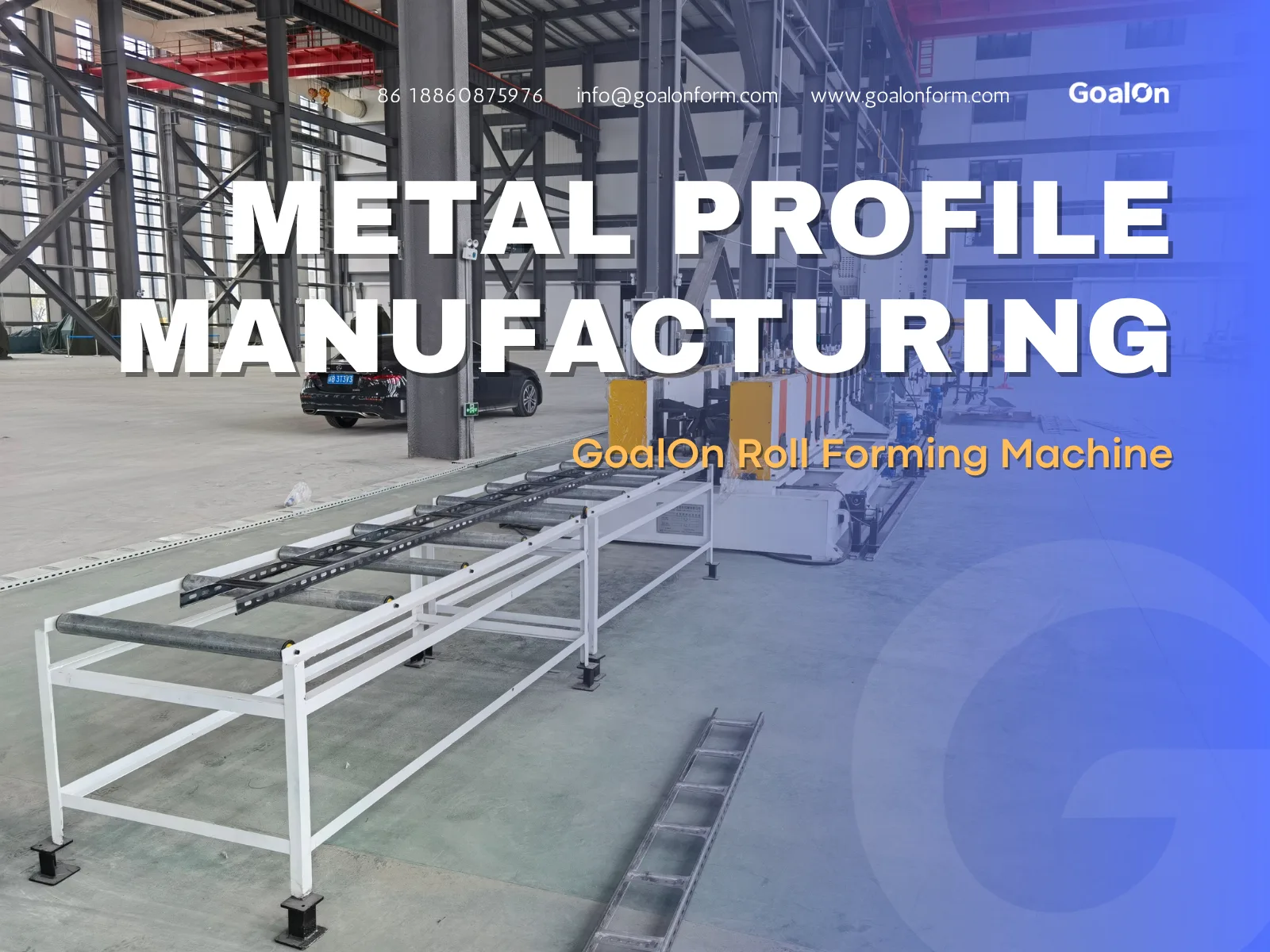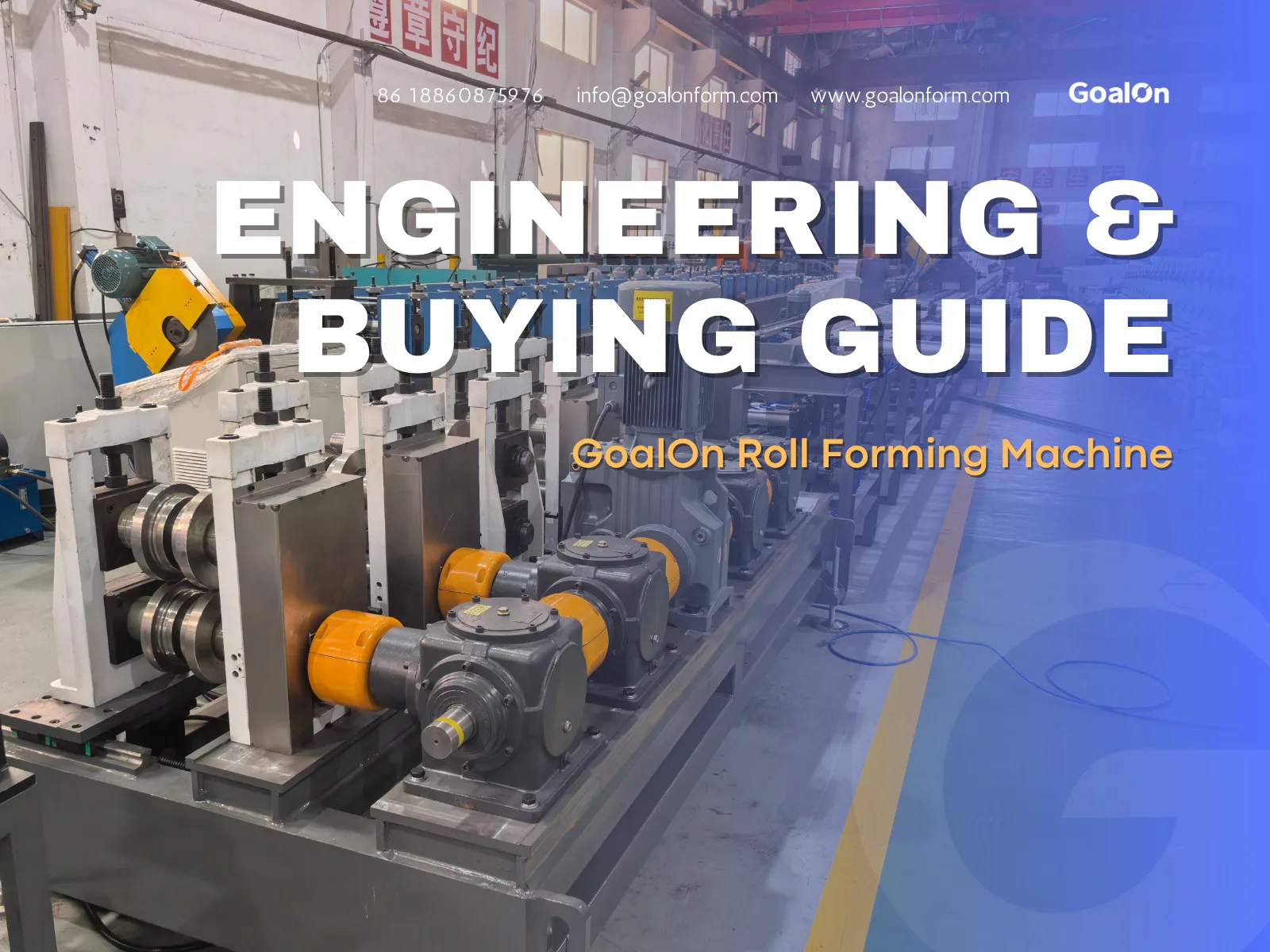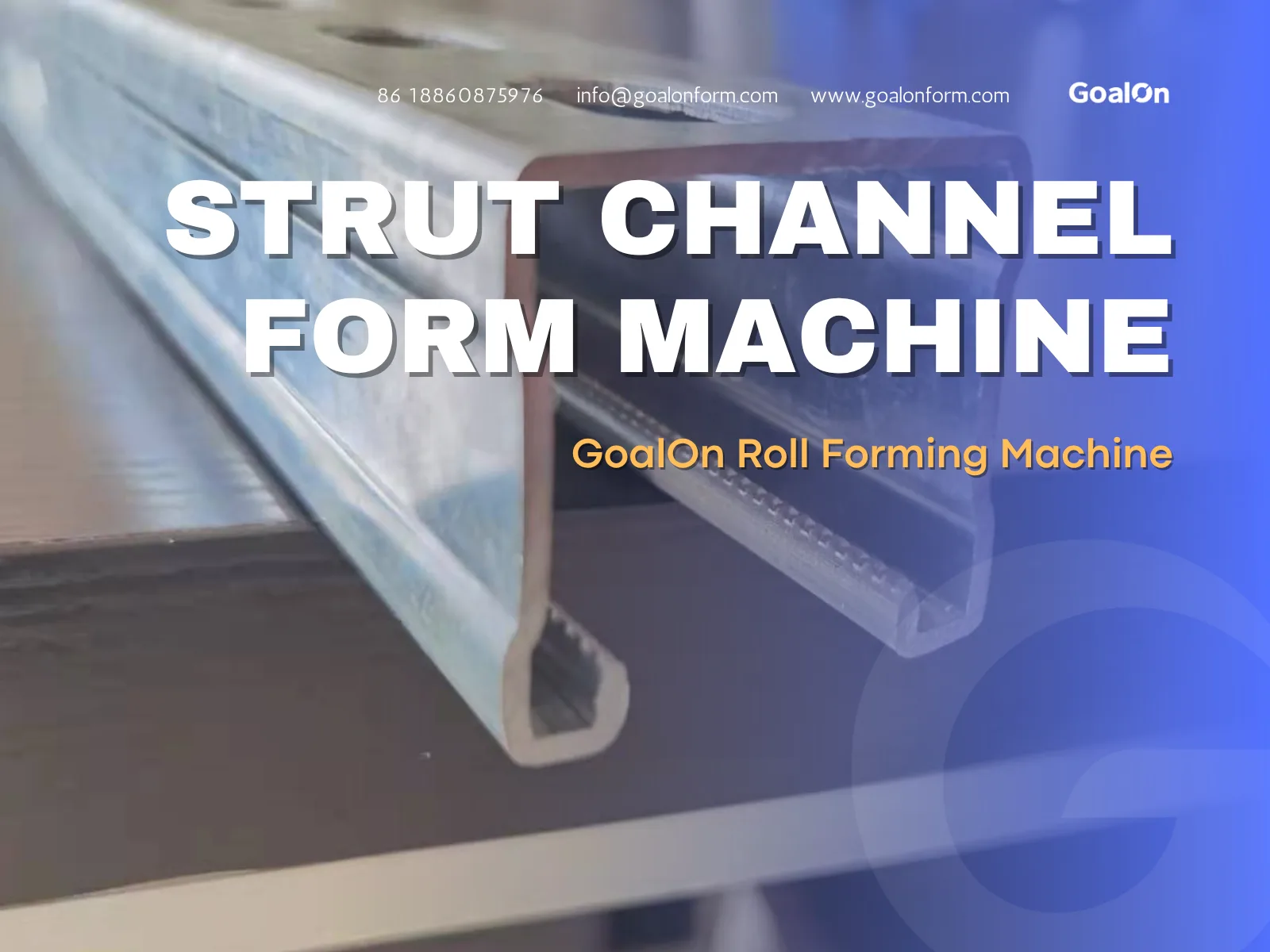
A Strut Channel Roll Forming Machine is an automated production line designed to manufacture high-precision strut channels from steel coils through continuous cold roll forming. It integrates key processes such as decoiling, feeding, punching, roll forming, and cutting into a single efficient workflow. Widely used in construction, electrical support systems, solar mounting, and industrial infrastructure, this machine delivers consistent dimensions, accurate hole patterns, and high production efficiency while reducing labor costs and material waste.
What Is a Uni Strut Channel Roll Forming Production Line?
A standard Uni Strut Channel Roll Forming Production Line converts steel coils into finished strut channels through a continuous, automated process. The basic configuration typically includes:
- Hydraulic decoiler
- Roll forming machine
- Cutting system
- Run-out table

For higher productivity and more demanding applications, manufacturers often add extra processing units before or after the roll forming machine. These options improve both product performance and production efficiency.
Common upgrades include:
- Punching system for slots and mounting holes
- Logo embossing unit for brand identification
- Serrated inturned edge (teeth edge) forming for improved grip and strength
- Upgraded forming stations for better profile accuracy
- Advanced flying cutting systems for continuous, high-speed production
The final strut channel production line should always be designed according to the required profile, hole pattern, material thickness, and target production speed. This ensures the best balance between product quality, efficiency, and investment cost.
Common Strut Channel Roll Forming Machine Solutions
Different manufacturers have different production needs. The right Strut Channel Roll Forming Machine depends on your product range, production volume, budget, and future expansion plans. Below are the four most common solutions used in the industry.
| Solution | Description | Advantages | Limitations | Best For |
|---|---|---|---|---|
| Solution 1: Single-Size Production Line | One roll forming machine is dedicated to producing a single strut channel size. | Lowest investment, simple operation, stable production, minimal maintenance, highest forming consistency. | Cannot produce other sizes without replacing the complete tooling. | Factories with high-volume production of one standard profile. |
| Solution 2: Manual Roller Change System | Multiple profiles are produced by manually replacing the roller sets on the same machine. | Lower equipment cost than purchasing multiple production lines. Supports several profile sizes. | Changeover is time-consuming and requires skilled operators. Production stops during tooling replacement. | Manufacturers producing multiple sizes with moderate output. |
| Solution 3: Automatic Size Adjustment System | The PLC control system automatically moves the forming rollers to adjust the forming positions for different channel sizes. | Fast changeover, minimal manual work, high automation, improved production efficiency. Suitable for frequent size changes. | Higher initial investment and more complex machine design. Profile range is limited by the machine design. | Customers requiring flexible production and frequent order changes. |
| Solution 4: Quick-Change Cassette Rolling System | Each profile has an independent cassette roller assembly. Different cassette units are installed onto the same roll former base using an overhead crane. | Highest profile accuracy, rapid tooling replacement, easier maintenance, reduced roller wear, supports complex profiles. | Higher tooling cost and requires lifting equipment for cassette replacement. | Large manufacturers producing many profile types, including rack box beam, strut channels, and customized sections. |
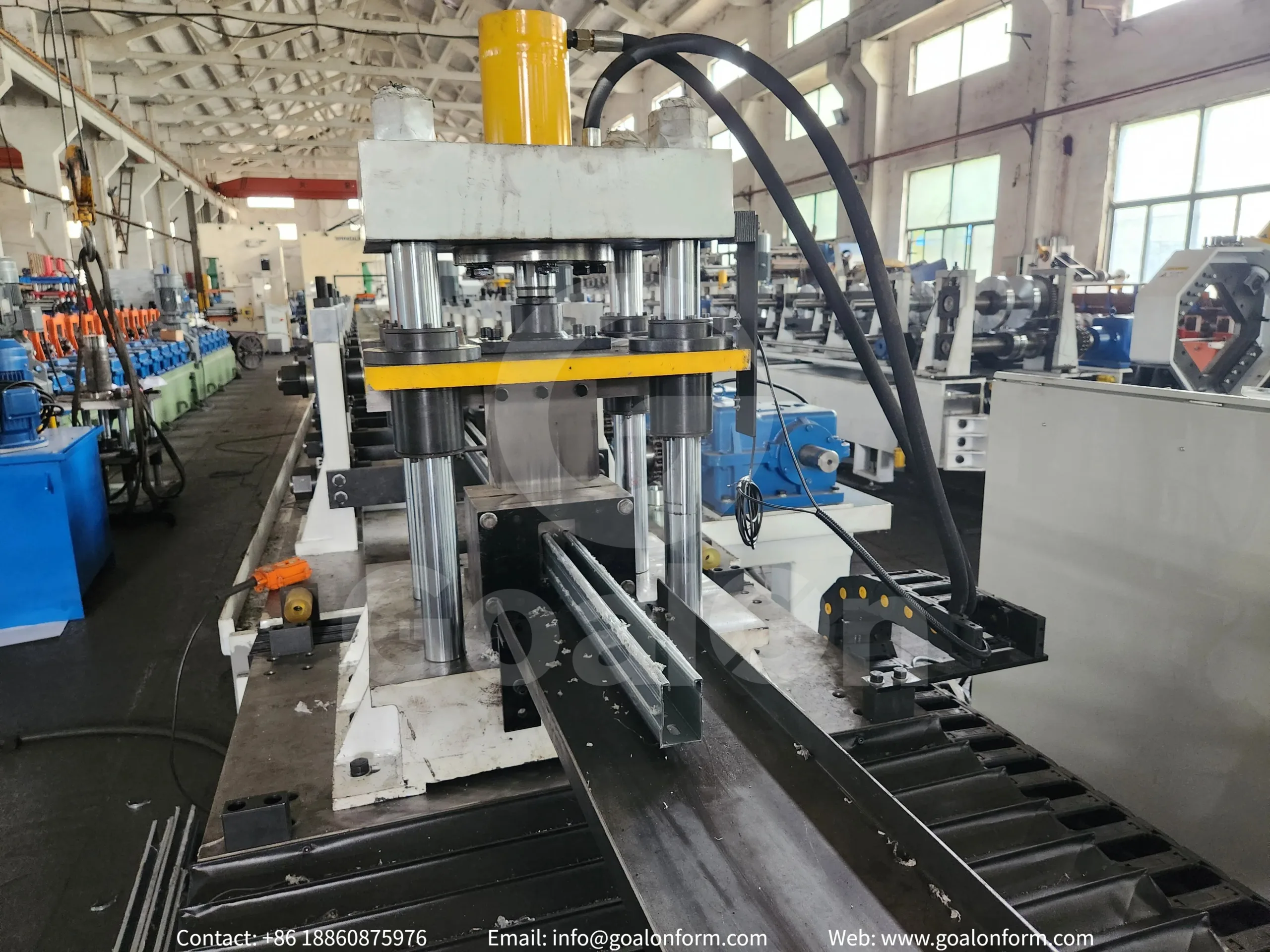
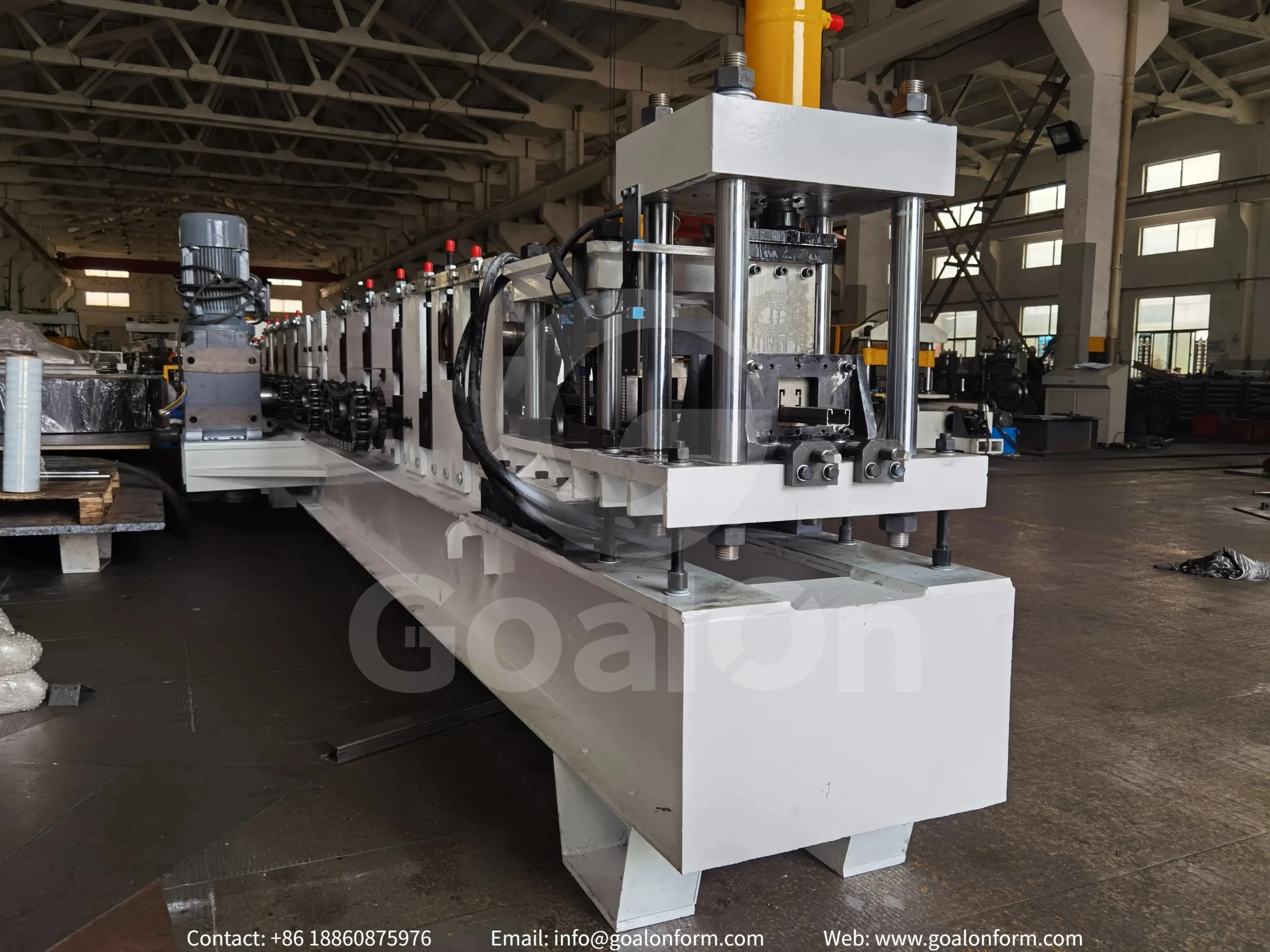
Which Solution Is Right for You?
There is no universal solution for every factory. The ideal strut channel production line should match your production goals.
- Choose Solution 1 for long-term production of one standard profile.
- Choose Solution 2 if you need multiple sizes with a limited budget.
- Choose Solution 3 when fast size change and automation are your priorities.
- Choose Solution 4 for the highest productivity, premium profile quality, and frequent production of multiple products such as Uni Strut channels, rack box beams, and other cold roll formed sections.
A professional Strut Channel Roll Forming Machine manufacturer should recommend the most suitable solution based on your drawings, production capacity, and future expansion plans—not simply the most expensive machine.
Common Strut Channel Sizes and Hole Patterns
Strut channel is one of the most widely used structural support components in modern construction and industrial installations. It provides a strong yet flexible framework for mounting pipes, cable trays, HVAC systems, electrical equipment, solar structures, and mechanical supports. Different projects require different channel sizes, materials, and hole patterns to meet specific load and installation requirements.
Common Sizes and Materials
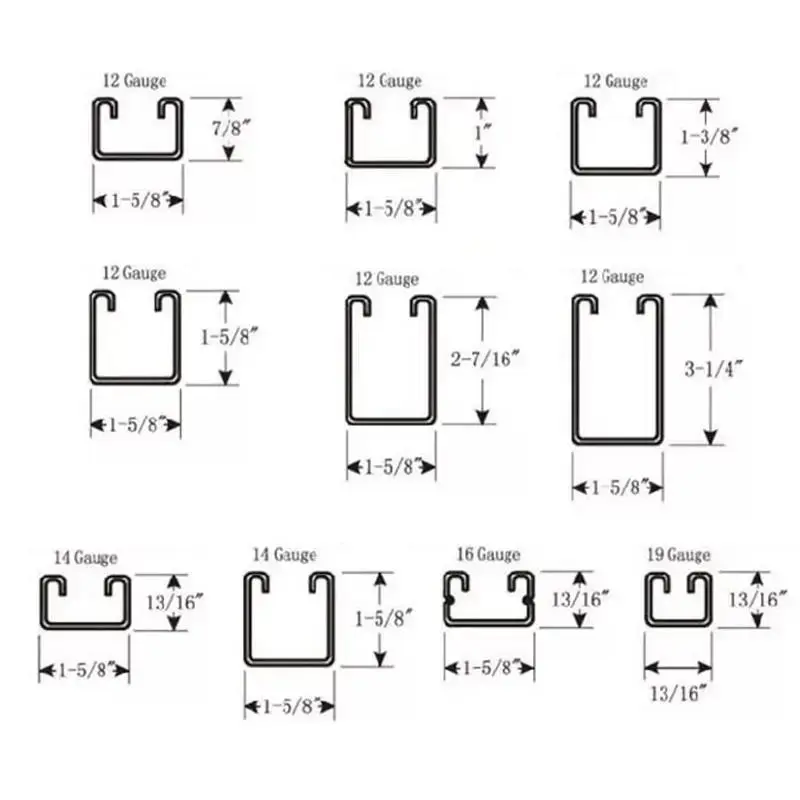
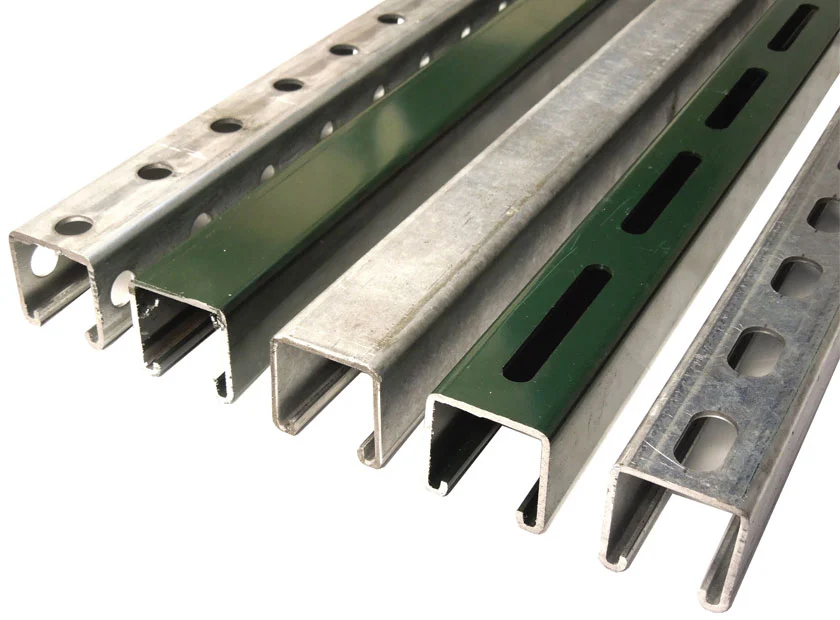
The most common Uni Strut channel sizes include 41×21 mm, 41×41 mm, 41×62 mm, and 41×82 mm, although custom dimensions are also widely used. Material selection depends on the application and service environment. Typical materials include:
- Pre-galvanized steel for indoor applications
- Hot-dip galvanized steel for outdoor and corrosive environments
- Stainless steel for chemical plants, food processing, and marine projects
The most common material thickness ranges from 1.5 mm to 3.0 mm, while heavy-duty applications may require thicker sections for higher load capacity.
Common Hole Patterns and Their Functions
The hole pattern directly affects both installation efficiency and structural performance. Common designs include:
- Round holes for standard bolt connections
- Slotted holes for flexible position adjustment during installation
- Long slots for greater mounting tolerance and alignment
- Custom hole patterns designed for project-specific requirements
Many strut channels also feature serrated inturned edges, which increase grip between channel nuts and fittings, helping prevent slipping under vibration or dynamic loads.
Today, cold roll forming remains the most efficient and economical method for manufacturing strut channels. It delivers high dimensional accuracy, consistent hole positioning, excellent material utilization, and stable quality, making it the preferred production process for both standard and customized strut channel profiles.
Who Uses a Strut Channel Roll Forming Machine?
The demand for Strut Channel Roll Forming Machines continues to grow as strut channels become a standard support solution across many industries. These machines are not only purchased by manufacturers of standard Uni Strut channels, but also by companies looking to expand their product range, improve production efficiency, or reduce outsourcing costs.
Industries That Use Strut Channels
Strut channels are widely used in projects that require strong, adjustable, and easy-to-install support systems. Common industries include:
- Commercial and industrial construction
- Electrical and cable management systems
- HVAC support systems
- Solar photovoltaic (PV) mounting systems
- Data centers and telecommunications
- Oil & gas facilities
- Water treatment plants
- Warehouses and logistics centers
- Manufacturing plants and industrial infrastructure
As these industries continue to grow, the demand for high-quality cold roll formed strut channels also increases.
Typical Buyers of Strut Channel Roll Forming Machines
A Strut Channel Production Line is a long-term investment. Buyers are usually companies with stable market demand and plans to expand their manufacturing capabilities. Typical customers include:
- Strut channel manufacturers increasing production capacity or adding new sizes.
- Roll forming companies expanding into products such as Uni Strut channels, cable tray systems, rack box beams, or other structural profiles.
- Steel service centers and metal processing companies moving from material supply to value-added manufacturing.
- Solar mounting system manufacturers producing support channels for photovoltaic projects.
- Electrical support system suppliers manufacturing channels for cable trays, conduits, and equipment installation.
- Warehouse racking manufacturers that also produce compatible structural components.
- OEM and contract manufacturers producing customized profiles for global brands.
- New investors and entrepreneurs entering the cold roll forming industry with customized production lines.
Whether serving the construction, energy, or industrial sectors, companies choose a Strut Channel Roll Forming Machine because it provides consistent product quality, lower labor costs, higher production efficiency, and flexible customization. As demand for modular support systems continues to rise worldwide, automated roll forming remains the most competitive manufacturing solution for both standard and customized strut channel products.
Why Choose Goalon Machinery for Your Strut Channel Roll Forming Machine?
Choosing a Strut Channel Roll Forming Machine manufacturer is about more than comparing prices. Long-term performance depends on engineering capability, machine stability, delivery reliability, and after-sales support. A lower initial price may lead to higher maintenance costs, longer downtime, and reduced production efficiency over the machine’s lifetime.
The table below compares Goalon Machinery with two typical suppliers in the market.
| Comparison Item | Goalon Machinery | Company A | Company B |
|---|---|---|---|
| Price Range | ★★★★☆ Competitive with premium value | ★★★★★ Lowest price | ★★☆☆☆ Highest price |
| Forming Speed | 15–30 m/min (depending on punching pattern) | 10–18 m/min | 18–25 m/min |
| Profile Accuracy | ±0.30 mm | ±0.60 mm | ±0.40 mm |
| Roller Material | Heat-treated GCr15, HRC58–62, hard chrome coated | 45# Steel | GCr15 |
| Shaft Material | 40Cr, heat treated | 45# Steel | 40Cr |
| Roller Change Time | 30–90 min (depending on machine type) | 2–4 hours | 1.5–2 hours |
| PLC & Software | Siemens PLC + HMI + remote troubleshooting | Standard PLC only | Siemens PLC |
| Technical Support | Lifetime online support | Limited online support | Online support during warranty |
| On-site Installation | Engineers available worldwide | Optional | Optional |
| Technical Training | Factory training + on-site commissioning + operation manuals | Basic operation training | Factory training only |
| Spare Parts Availability | Long-term supply with standardized inventory | Order upon request | Limited stock |
| Warranty | 24 months | 12 months | 12–18 months |
| Lead Time | 60–90 days | 90–120 days | 75–100 days |
| Customization Capability | Complete line design based on drawings, capacity, and plant layout | Standard models only | Partial customization |
Goalon Machinery focuses on the entire production line, not just the roll former itself. Our engineers optimize every stage, from decoiling and punching to roll forming and cutting, based on your profile drawings and production goals. This approach improves machine stability, reduces changeover time, and ensures consistent product quality. Whether you need a standard Uni Strut Channel Roll Forming Machine or a fully customized solution with automatic size adjustment and high-speed punching, our team provides professional engineering support throughout the project lifecycle.
Strut Channel Production Line Configuration – Decoiler
The decoiler is the first unit in a Strut Channel Production Line. Its main function is to hold the steel coil and provide stable material feeding for the roll forming process.
A basic option is a manual decoiler (non-powered decoiler). The coil expansion and braking force are adjusted manually, which makes operation simple but limits production efficiency, especially for long-time continuous production.
For professional Strut Channel Roll Forming Machines, we usually recommend a hydraulic decoiler. Compared with a manual type, a 3-ton hydraulic decoiler normally increases the equipment cost by around USD 4,000–5,000. However, it provides faster coil loading, automatic expansion, and more stable feeding, which improves overall production efficiency and reduces labor requirements in long-term operation.
Strut Channel Production Line Configuration – Punching Methods
The punching process is one of the most important parts of a Strut Channel Production Line. Different punching solutions affect production speed, hole accuracy, tooling cost, and overall automation level. The right Strut Channel Punching System should be selected according to profile thickness, hole pattern, production capacity, and budget.
Solution 1: Servo Feeder + Hydraulic Punching Machine
Basic: Uses an independent servo feeding system and hydraulic punching unit before roll forming.
Speed: Suitable for medium-speed production with high punching accuracy.
Suitable For: Standard and customized strut channels with various hole patterns.
Advantages: High positioning accuracy, flexible hole design, and easy maintenance. Ideal for small-batch and multi-profile production.
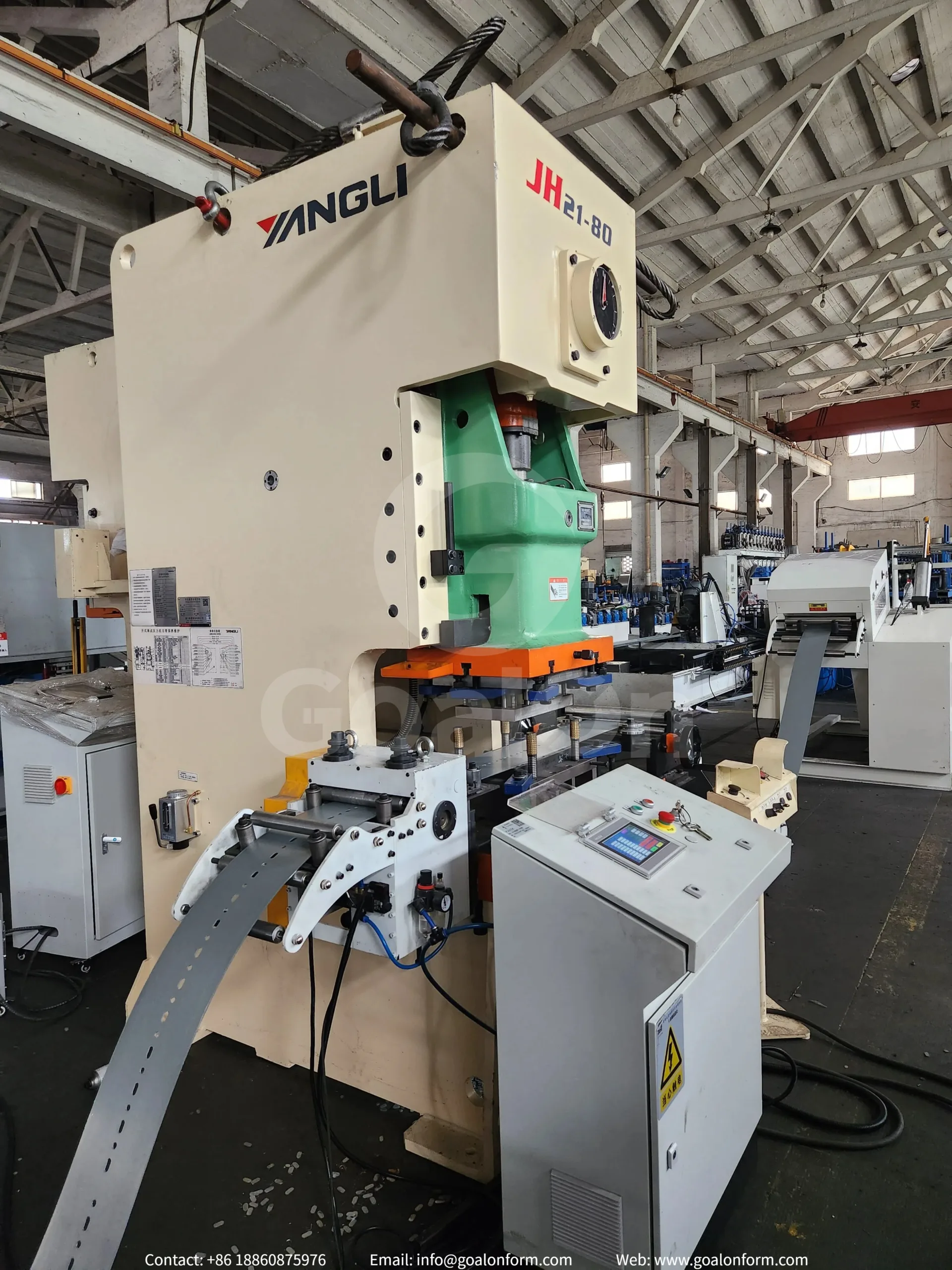
Solution 2: Punch Press System
Basic: Uses a mechanical punch press to create holes before the roll forming process.
Speed: High punching speed, suitable for large-volume production.
Suitable For: Stable production of standard profiles with fixed hole patterns.
Advantages: Fast cycle time and strong punching force. Good choice for customers requiring high output and consistent production.
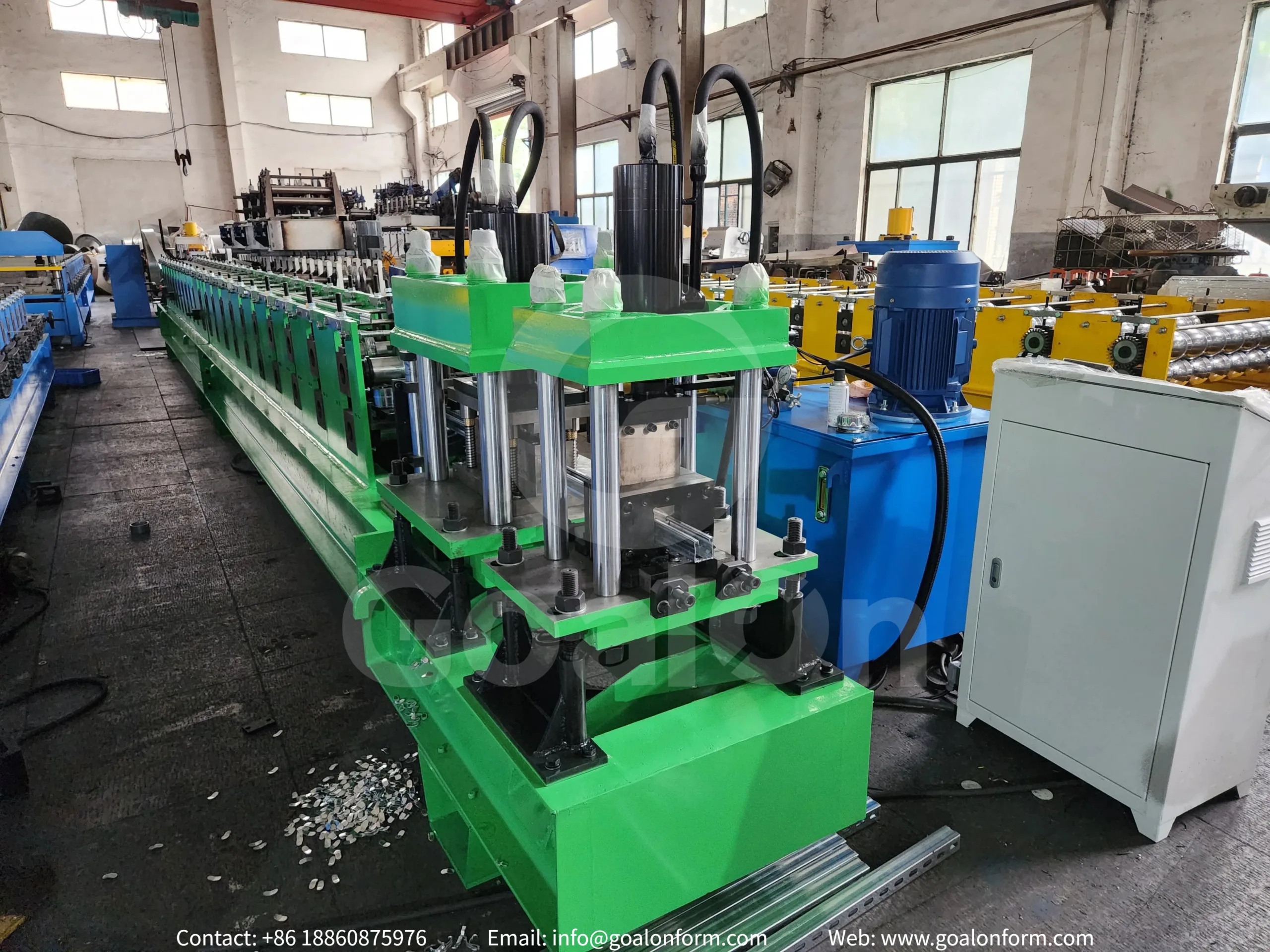
Solution 3: Pre-Punching Before Roll Forming (Main Machine Hydraulic Punching)
Basic: Hydraulic punching units are installed before the forming stations on the roll forming machine.
Speed: Medium to high speed depending on hole pattern and material thickness.
Suitable For: Continuous production of commonly used strut channel profiles.
Advantages: Integrated production process, reduced floor space, and synchronized operation with the roll former.
Solution 4: Post-Punching After Roll Forming (Stop or Flying Punching)
Basic: Holes are punched after the profile is formed using stop punching or tracking punching technology.
Speed: Tracking punching provides higher efficiency for continuous production.
Suitable For: Profiles requiring accurate hole positions after forming.
Advantages: Better dimensional control, especially for complex profiles where forming may affect hole position accuracy.
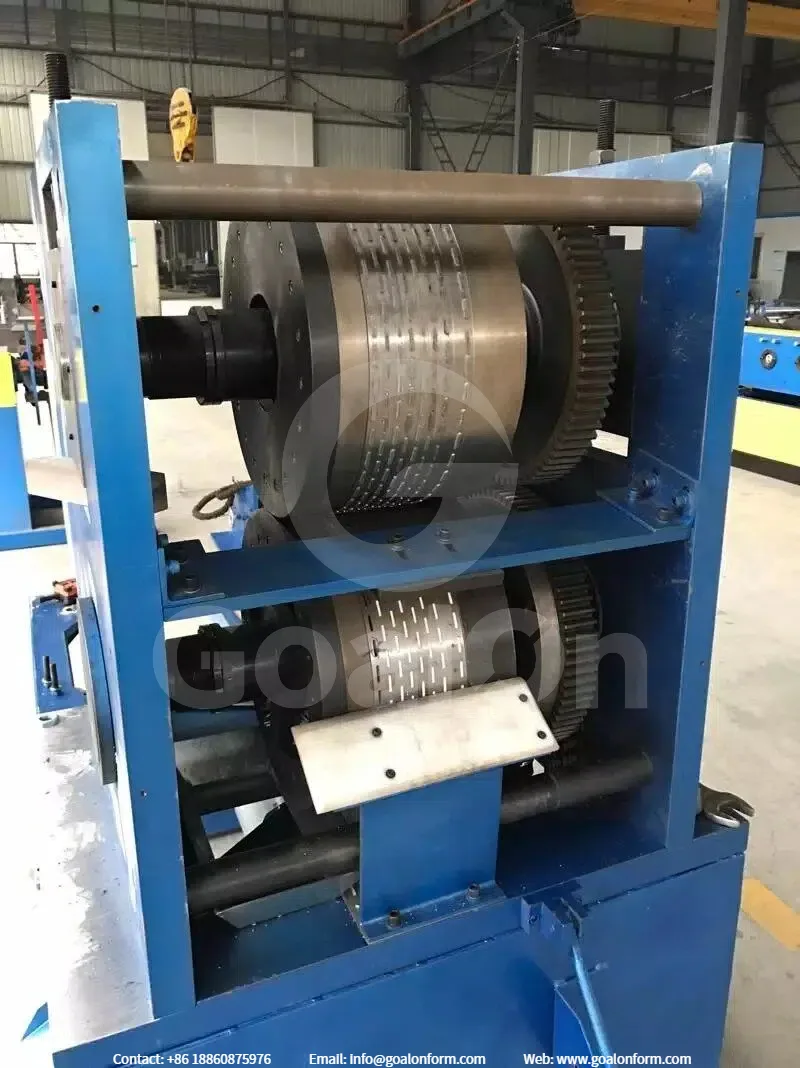
Solution 5: Roll Punching System
Basic: Uses rotating punching rollers to create holes during continuous forming.
Speed: The fastest punching solution for high-speed production lines.
Suitable For: Large-volume production with fixed hole patterns.
Advantages: No production stopping, continuous operation, and maximum efficiency. Suitable for customers requiring high-speed automatic strut channel manufacturing.
For a professional Uni Strut Channel Roll Forming Machine, the punching method should not only consider speed but also the balance between hole accuracy, tooling cost, production flexibility, and future product requirements. Goalon Machinery can design the suitable punching solution according to your strut channel drawings and production goals.
Strut Channel Production Line Configuration – Cutting Methods
The cutting system is the final processing step in a Strut Channel Roll Forming Machine. It directly affects the finished profile length accuracy, cutting surface quality, and production efficiency. According to different production requirements, strut channel production lines mainly use hydraulic cutting systems or saw cutting systems.
Both cutting methods can be designed as stop cutting or tracking cutting (flying cutting). Stop cutting requires the roll forming line to pause before cutting, while tracking cutting allows the cutter to move together with the profile and complete cutting during continuous production. Tracking cutting provides higher efficiency and is more suitable for automatic high-speed production lines.
Solution 1: Hydraulic Cutting System
Basic: Uses a hydraulic cylinder and cutting die to cut formed strut channels into fixed lengths.
Speed: Medium to high speed, depending on whether stop cutting or tracking cutting is selected.
Suitable For: Standard Uni Strut channels with common thickness and clean cutting requirements.
Advantages: No metal chips, low material waste, and smooth cutting edges. It provides reliable performance and is widely used in strut channel production.
Hydraulic cutting is a popular choice for customers who focus on stable production, simple maintenance, and consistent product appearance.
Solution 2: Saw Cutting System
Basic: Uses a circular saw blade to cut the finished strut channel profile.
Speed: Medium speed, with tracking saw cutting available for continuous production.
Suitable For: Heavy-duty strut channels, thicker materials, and profiles requiring flexible cutting solutions.
Advantages: Strong cutting capability and excellent adaptability for different materials and profile designs.
Saw cutting is especially suitable when the channel thickness is higher or when customers require a universal cutting method for multiple products.
For a professional Strut Channel Production Line, the cutting solution should be selected based on material thickness, production speed, profile requirements, and future product expansion. Goalon Machinery can provide customized hydraulic cutting or saw cutting systems to achieve the best balance between efficiency, accuracy, and investment cost.
Strut Channel Production Line Configuration – Other Design
In a professional Strut Channel Production Line, each process needs to work together smoothly. The punching system and roll forming machine may operate at different speeds. To reduce speed differences and improve production stability, an additional material storage and buffering system can be installed between the punching unit and the roll forming machine.
This design helps control coil movement, reduce tension changes, and maintain continuous production.
Solution 1: Material Storage Rack
A material storage rack is a simple buffering device that stores a certain amount of punched steel strip before it enters the roll forming machine.
Advantages:
- Simple structure and easy installation
- Requires less factory space
- Lower investment cost
- Suitable for standard production requirements
This solution is commonly used when the production speed difference between punching and forming is not large.
Solution 2: Underground Loop Pit
An underground loop pit creates a larger material storage area below the production line. The steel strip forms a loop inside the pit, allowing the punching system and roll forming machine to operate more independently.
Advantages:
- Better speed coordination and production stability
- Reduces material tension during high-speed operation
- Suitable for automatic and high-output strut channel manufacturing lines
However, the underground pit design must consider the customer’s factory conditions, including floor structure, available space, and installation requirements. A safety fence and protection system are also necessary to ensure safe operation around the pit area.
For high-speed Uni Strut Channel Roll Forming Machines, a properly designed buffering system can improve the overall efficiency, reduce downtime, and create a more stable automatic production process. Goalon Machinery can design the most suitable layout based on your production speed, punching method, and workshop conditions.
Fully Customized Strut Channel Roll Forming Solutions
Every customer has different production goals. Some manufacturers add extra functions to their Strut Channel Roll Forming Machine for branding, traceability, and production management.
Common optional upgrades include:
- Logo embossing system for permanent brand identification on the strut channel surface
- Inkjet printing system using fast-drying ink for printing product codes, batch numbers, or production information
- Automatic stacking system to replace the standard non-powered run-out table and improve material handling efficiency
With these options, the Strut Channel Production Line can achieve a high level of automation and production completeness. However, the best solution is always based on the customer’s actual requirements. Goalon Machinery combines years of roll forming experience with each customer’s profile drawings, production targets, and factory conditions to optimize the most suitable production line configuration.
FAQ
Do I need a material storage rack or underground loop pit?
Not every project requires a buffering system. A material storage rack is suitable for standard production with moderate speed requirements. An underground loop pit provides better speed coordination between punching and forming, making it suitable for high-speed automatic production lines. The final choice depends on factory layout, available space, and safety requirements.
What punching methods are available for strut channel production?
Different punching solutions are available, including:
Servo feeder + hydraulic punching machine
Punch press system
Pre-punching before roll forming
Post-punching after roll forming
Roll punching system
The selection depends on hole pattern, production speed, profile thickness, and required flexibility.
What thickness can a strut channel roll forming machine produce?
The standard thickness range is usually around 1.5–3.0 mm. For heavy-duty strut channels or special applications, the machine can be designed for thicker materials after checking the profile drawing, coil specifications, and required load capacity.
What steel materials can be used for strut channel production?
The machine can process different steel materials, including pre-galvanized steel, hot-dip galvanized steel, and stainless steel. The suitable material depends on the application environment, such as indoor construction, outdoor structures, chemical plants, or marine projects.
Can one strut channel roll forming machine produce multiple sizes?
Yes. There are several solutions depending on production requirements. A machine can use manual roller changing, automatic size adjustment, or quick-change cassette tooling systems to produce multiple strut channel sizes. The best solution depends on the number of profiles, production frequency, and investment budget.
What sizes of strut channels can be produced by a Strut Channel Roll Forming Machine?
A Strut Channel Roll Forming Machine can be designed to produce common sizes such as 41×21 mm, 41×41 mm, 41×62 mm, and 41×82 mm. Customized dimensions are also possible according to customer drawings, including different heights, widths, thicknesses, and edge designs.