Metal roofing sheets are widely used in residential, commercial, industrial, and agricultural buildings. They are available in different profiles, each designed for specific appearance, structural, and installation requirements. Among the most common options are step tile, trapezoidal, and corrugated roofing sheets.
Although all three products are made from formed metal coils, their cross-sectional shapes, surface patterns, applications, and manufacturing processes are different. These differences also affect the design of the roll forming machine.
In this guide, we compare three popular types of Metal Roofing Sheets, explain where they are commonly used, and explore why each profile requires a suitable manufacturing solution.
1. Understanding the Three Main Types of Metal Roofing Sheets
Before comparing their performance and applications, it is important to understand the basic structure of each roofing profile.
1.1 Step Tile Roofing Sheets
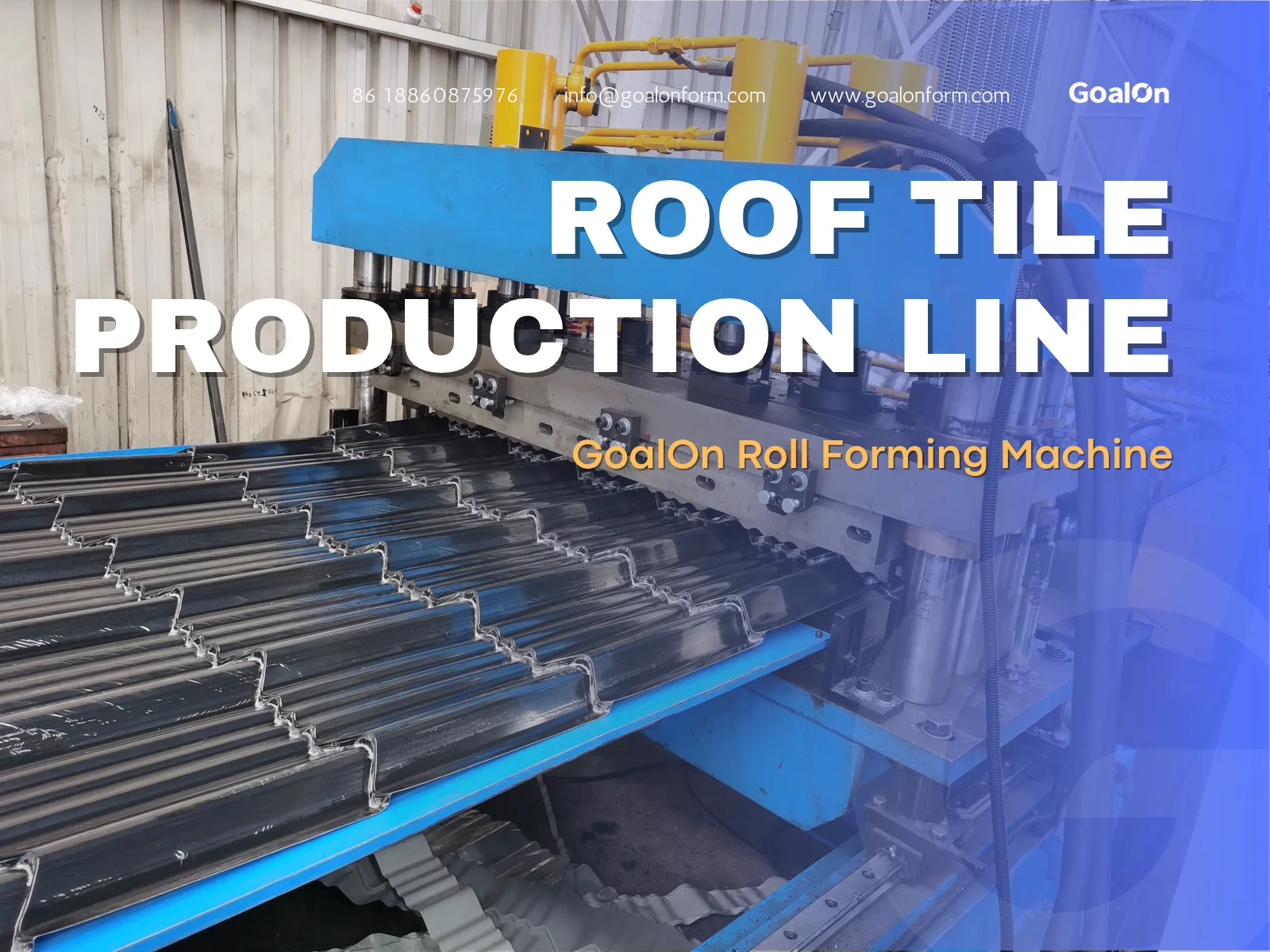
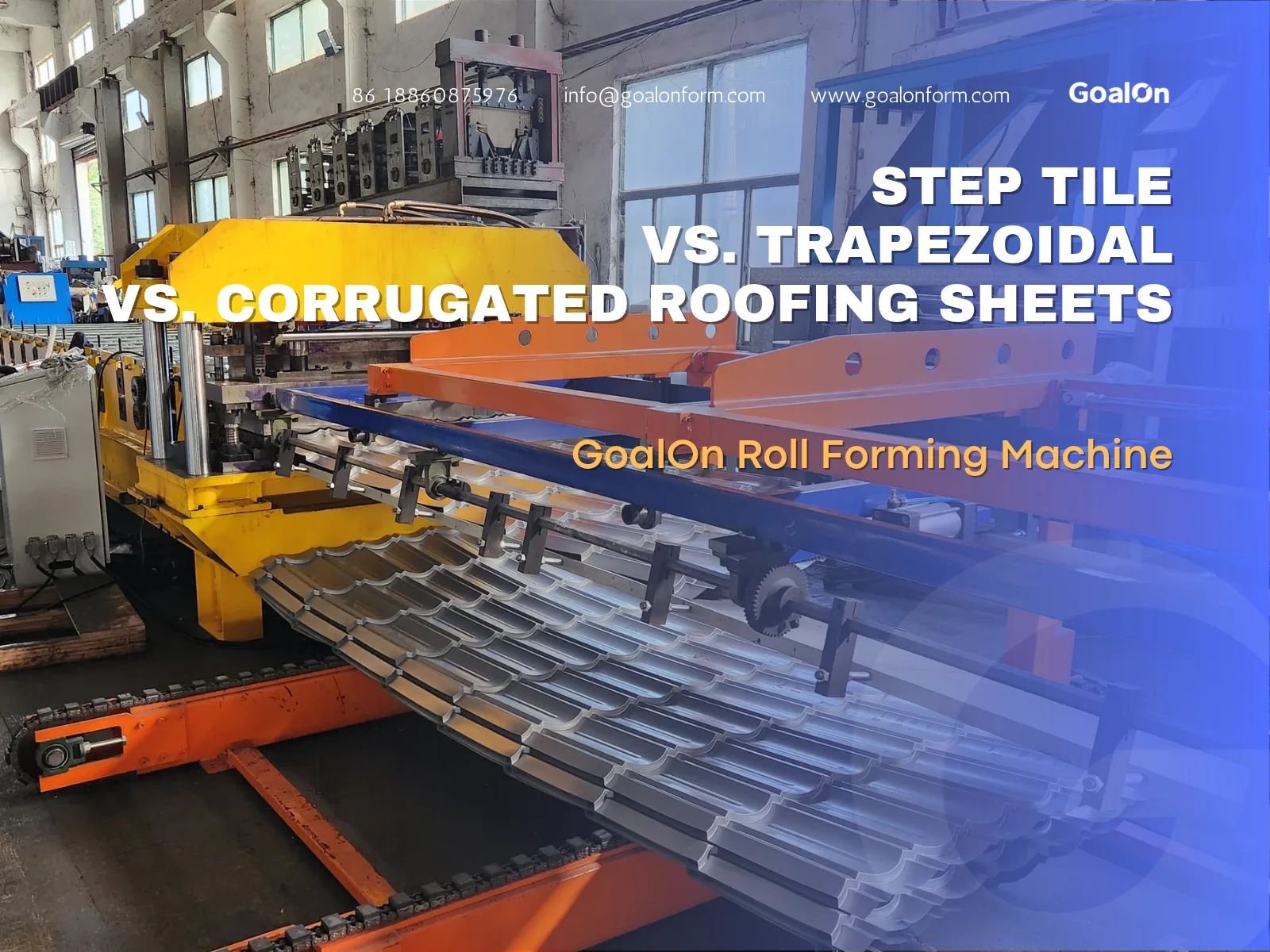
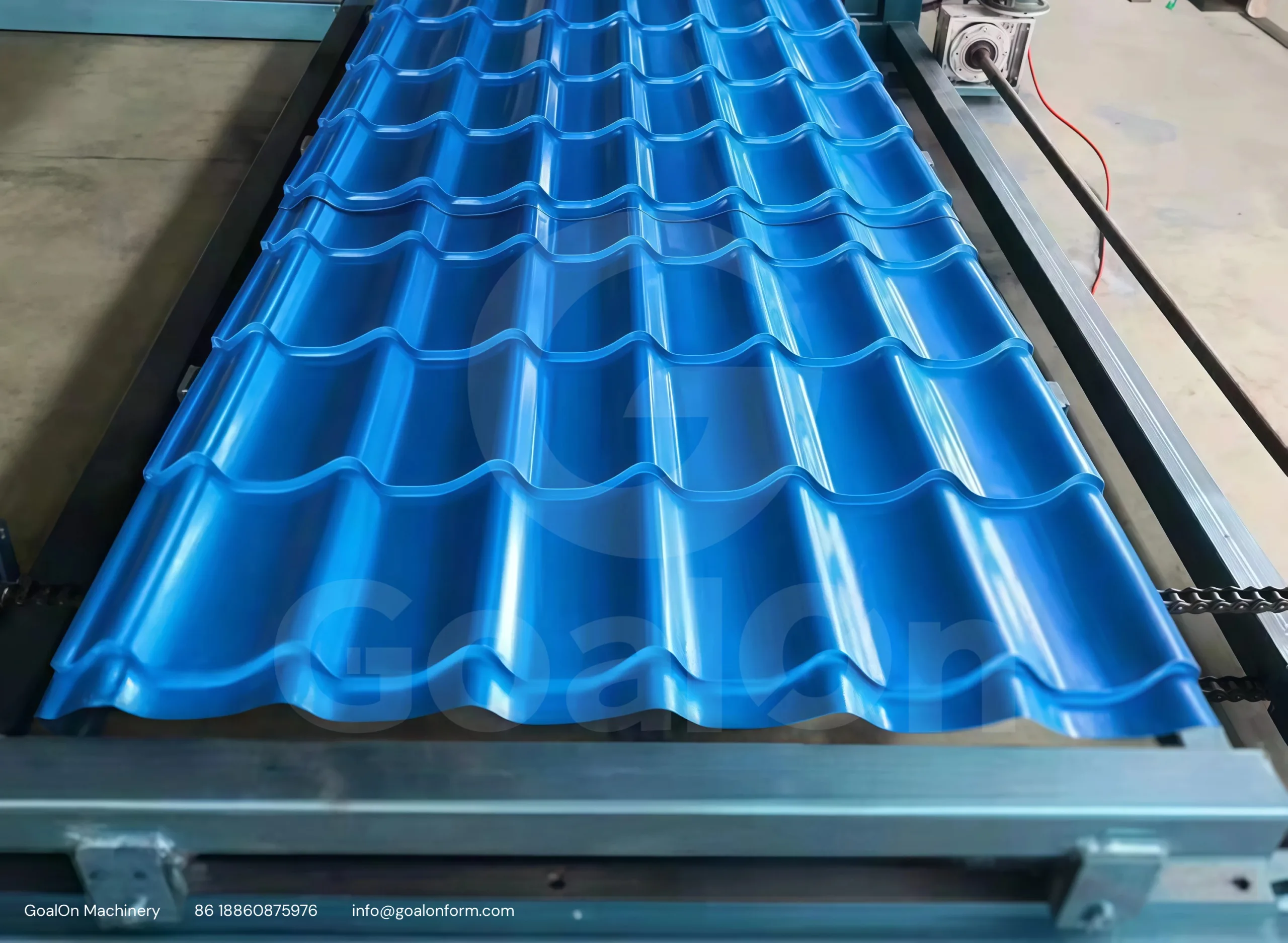
Step tile roofing sheets are metal panels designed to resemble traditional roof tiles. Their surface features repeated raised and recessed sections that create a layered, tile-like appearance.
Unlike traditional clay or concrete tiles, metal step tiles are usually produced from galvanized steel or pre-painted steel coils. They combine the visual appeal of conventional roof tiles with the advantages of continuous metal sheet production.
Their main characteristics include:
- Tile-like appearance: Transverse steps create the visual effect of individual roof tiles.
- Lightweight construction: Metal panels are generally lighter than traditional clay or concrete tiles of comparable roof coverage.
- Consistent profile: Mechanical forming helps maintain uniform step dimensions.
- Decorative applications: Available in different colors, coatings, and profile designs.
Step tile panels are commonly used for residential buildings, villas, renovation projects, and architectural roofing where appearance is an important consideration.
One important detail is that the transverse steps are not simply ordinary longitudinal ribs. Depending on the profile, the production line may need a coordinated pressing or stamping operation after the initial roll forming process.

1.2 Trapezoidal Roofing Sheets
Trapezoidal roofing sheets feature a series of straight ribs with sloped side walls and relatively flat tops. Their cross-section resembles a series of connected trapezoids.
This profile is widely used in industrial and commercial construction because the raised ribs improve the sheet’s stiffness compared with a flat metal sheet of the same material thickness.
Common characteristics include:
- Raised structural ribs: Rib height and spacing influence panel stiffness.
- Wide flat sections: These areas provide a relatively simple panel surface.
- Practical installation: The profile can be designed for side-lap connections.
- Flexible configurations: Different rib heights, pitches, and cover widths are available.
Trapezoidal panels are frequently used for factory roofs, warehouses, workshops, agricultural buildings, and metal wall cladding.
Some common profile names include TR35, TR40, TR45, and other region-specific designs. However, these names do not always represent identical dimensions across different manufacturers or markets.
When selecting a trapezoidal panel, buyers should check the actual cross-section drawing rather than rely only on the profile name.
1.3 Corrugated Roofing Sheets
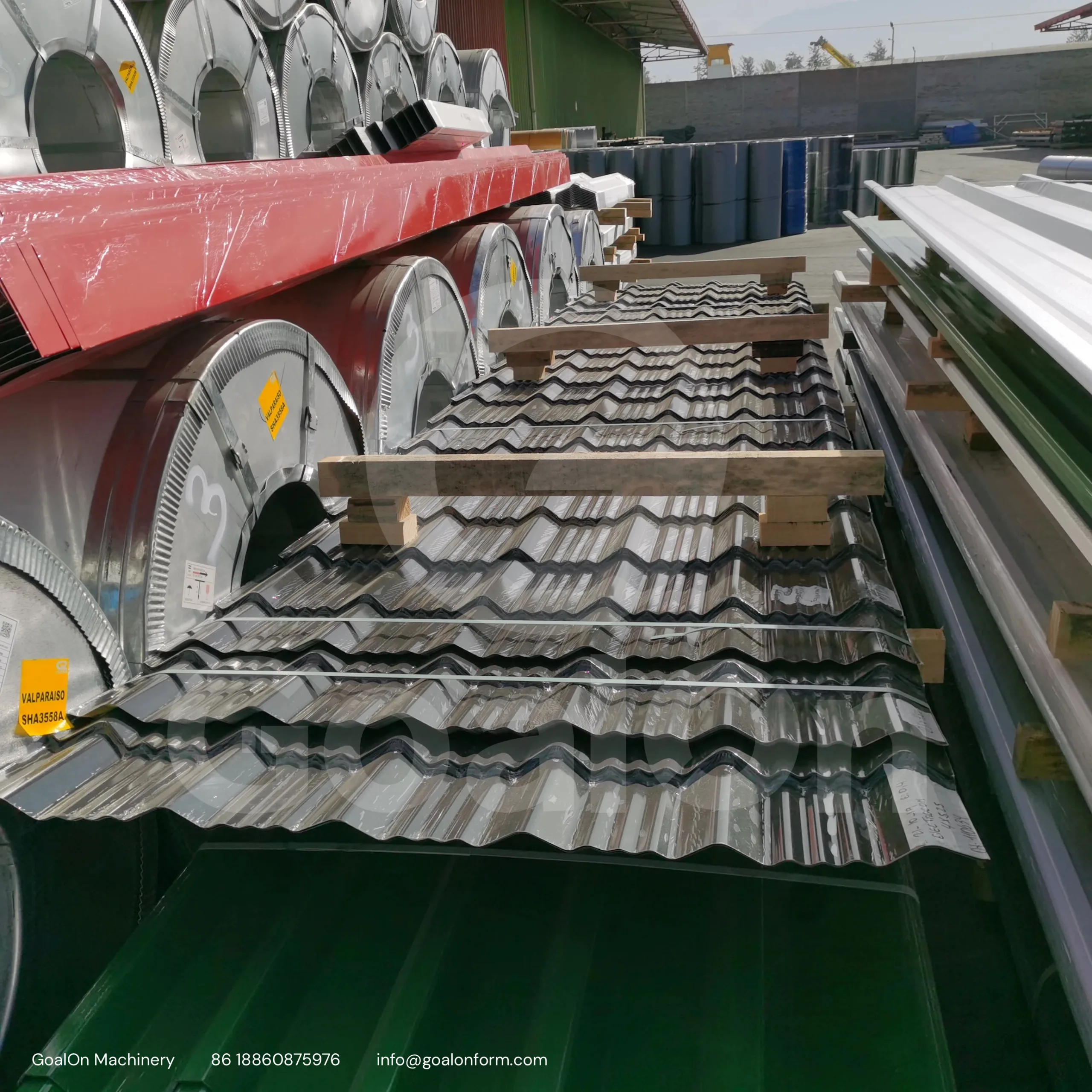
Corrugated roofing sheets have a continuous wave-shaped cross-section. Unlike trapezoidal panels, their ribs have smooth curved surfaces rather than flat tops and straight sloped sides.
This simple and recognizable design has been used in metal roofing for many years.
Key characteristics include:
- Curved wave profile: Repeated rounded waves form the panel surface.
- Traditional appearance: Suitable for both modern and conventional building designs.
- Relatively simple geometry: The profile can be produced through a dedicated series of forming rollers.
- Versatile applications: Used for roofing, wall cladding, agricultural buildings, and general-purpose structures.
Corrugated metal sheets are popular in agricultural buildings, storage facilities, workshops, sheds, and renovation projects.
Their actual load capacity and suitability depend on wave depth, material thickness, support spacing, fastening details, and structural design.
2. Step Tile vs. Trapezoidal vs. Corrugated: Key Differences
Although these three products all use cold roll forming technology, their profile structures and manufacturing requirements are different.
The following table provides a practical comparison.
| Comparison | Step Tile | Trapezoidal | Corrugated |
|---|---|---|---|
| Cross-section | Tile-like stepped pattern | Straight ribs with sloped sides | Continuous curved waves |
| Main appearance | Traditional roof tile effect | Modern industrial appearance | Classic wave pattern |
| Surface structure | Longitudinal profile with transverse steps | Repeated trapezoidal ribs | Repeated sinusoidal curves |
| Main applications | Residential and decorative roofing | Industrial and commercial roofing | Agricultural, industrial and general roofing |
| Forming requirements | Roll forming with additional step-forming operations where required | Progressive roll forming | Progressive roll forming |
| Main tooling consideration | Roller profile and step-forming tooling | Rib height, pitch and bend geometry | Wave radius, pitch and forming sequence |
| Typical production complexity | Relatively high | Moderate | Moderate, depending on profile |
There is no universally best profile among these three options.
Step tile is often selected for its appearance. Trapezoidal panels are widely used where rib geometry and structural performance are important. Corrugated sheets offer a familiar wave design for a wide range of general roofing applications.
However, roofing performance cannot be determined by appearance alone. Material thickness, yield strength, profile dimensions, support spacing, fastening methods, and local design requirements must all be considered.
For a reliable comparison, manufacturers should evaluate the complete roofing system rather than only the metal sheet itself.
3. Where Are These Metal Roofing Profiles Used?
Different roofing profiles serve different market needs. Understanding their applications helps manufacturers choose the right products and plan suitable production equipment.
3.1 Residential and Architectural Roofing
Step tile roofing sheets are particularly suitable for projects where the appearance of the roof is important.
Examples include:
- Private houses and villas.
- Residential communities.
- Holiday resorts and guesthouses.
- Building renovation projects.
- Decorative roofing applications.
The tile-like pattern creates a more traditional roof appearance while retaining the advantages of metal construction.
Some architectural projects also use trapezoidal or corrugated sheets, especially when a modern industrial or simple appearance is preferred.
3.2 Industrial and Commercial Buildings
Trapezoidal roofing sheets are widely used for factories, warehouses, logistics centers, workshops, and commercial buildings.
Their raised ribs provide greater geometric stiffness than a flat sheet, while the profile can be engineered to meet specific structural requirements.
For large buildings, buyers often focus on:
- Rib height and spacing.
- Effective cover width.
- Material thickness and strength.
- Roof support spacing.
- Wind and snow load requirements.
- Installation and fastening systems.
Corrugated sheets are also used in industrial buildings, particularly where their wave profile matches the project’s design and structural requirements.
3.3 Agricultural and General-Purpose Buildings
Corrugated roofing sheets are commonly selected for barns, farm storage buildings, sheds, workshops, and other practical structures.
Their curved profile offers a recognizable appearance and can be produced in different wave dimensions.
Trapezoidal panels are also suitable for agricultural applications, especially when a specific rib configuration is required.
For these projects, the selection should consider the local climate, building structure, corrosion protection, and expected service conditions.
A suitable profile is not simply the one with the lowest material cost. It should meet the building’s functional requirements throughout its expected service life.
4. How Are Different Roofing Profiles Manufactured?
The main manufacturing difference between these products comes from their geometry.
All three can use metal coil as the starting material, but their roller designs, forming sequences, and additional processing requirements are not necessarily the same.
4.1 Step Tile Roll Forming and Pressing Process
A step tile production line generally starts with a metal coil mounted on a decoiler.
The material passes through the leveling and feeding sections before entering the roll forming unit.
The rollers gradually create the required longitudinal profile. A hydraulic pressing or stamping system then produces the transverse steps according to the product design.
A typical production process includes:
- Decoiling: Releasing the metal coil.
- Leveling: Reducing coil curvature.
- Feeding: Controlling the material position and feeding length.
- Roll forming: Creating the longitudinal profile.
- Step pressing: Producing the required tile pattern.
- Cutting: Separating the finished panels to the required length.
- Stacking: Collecting the completed products.
The pressing operation requires accurate coordination with the feeding system. Incorrect positioning may cause uneven step spacing or inconsistent panel lengths.
Therefore, a step tile line often requires more process coordination than a standard continuous roofing sheet line.
4.2 Trapezoidal Roof Sheet Roll Forming Process
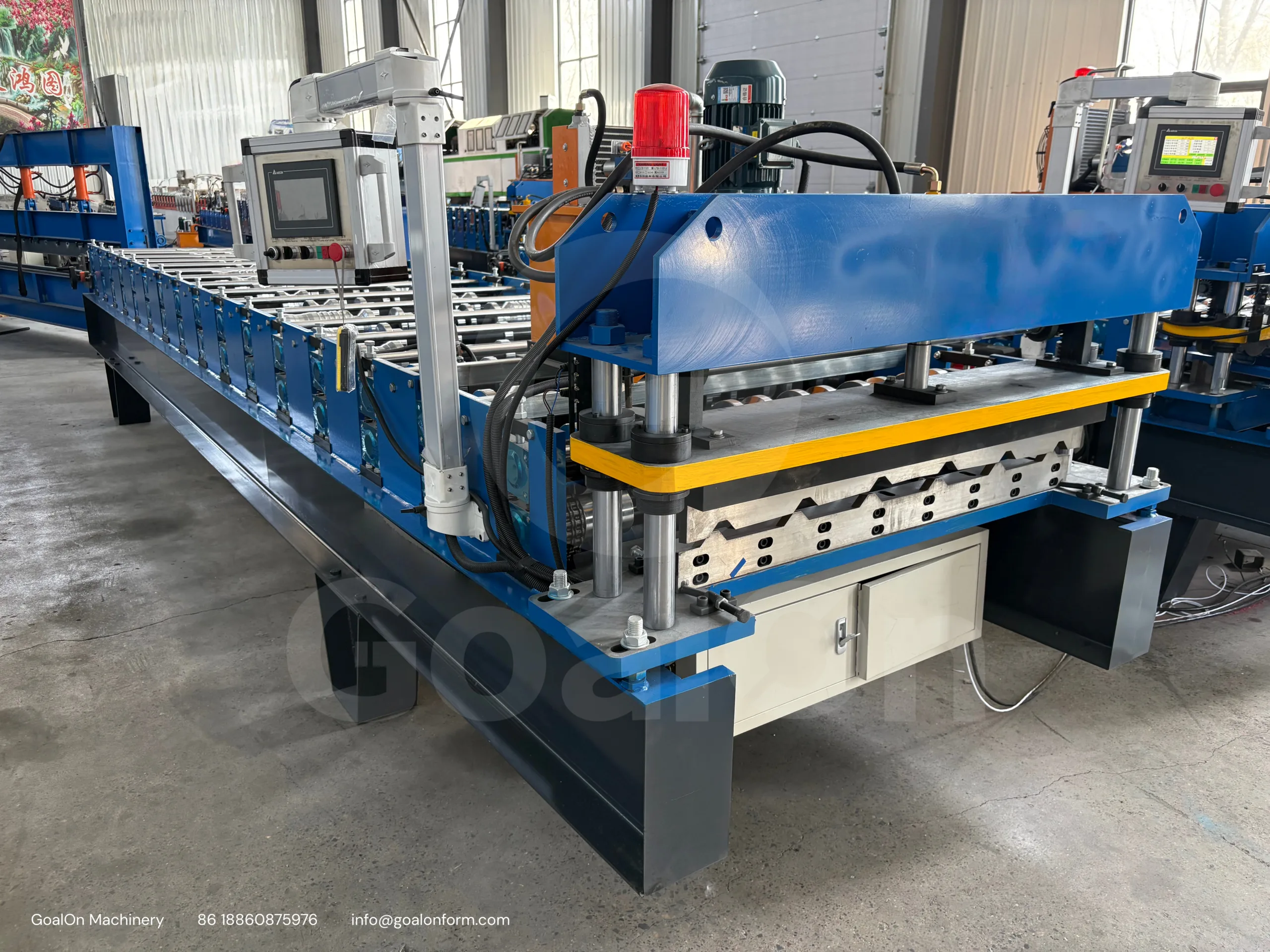
Trapezoidal roofing sheets are generally produced through continuous roll forming.
After decoiling, leveling, and feeding, the flat metal strip passes through multiple roller stations.
Each station gradually bends the material to create the required trapezoidal ribs.
The forming sequence must control the deformation of the sheet. If the ribs are formed too aggressively, the material may develop edge waves, surface marks, or unwanted distortion.
The main engineering considerations include:
- Rib height and pitch.
- Top width and bottom width.
- Side wall angle.
- Bend radius.
- Roller clearance.
- Material thickness and mechanical properties.
Once the required profile is formed, the cutting system separates the sheet at the specified length.
Because trapezoidal profiles vary significantly between markets, the roller tooling should be designed according to the actual product drawing.
4.3 Corrugated Sheet Roll Forming Process
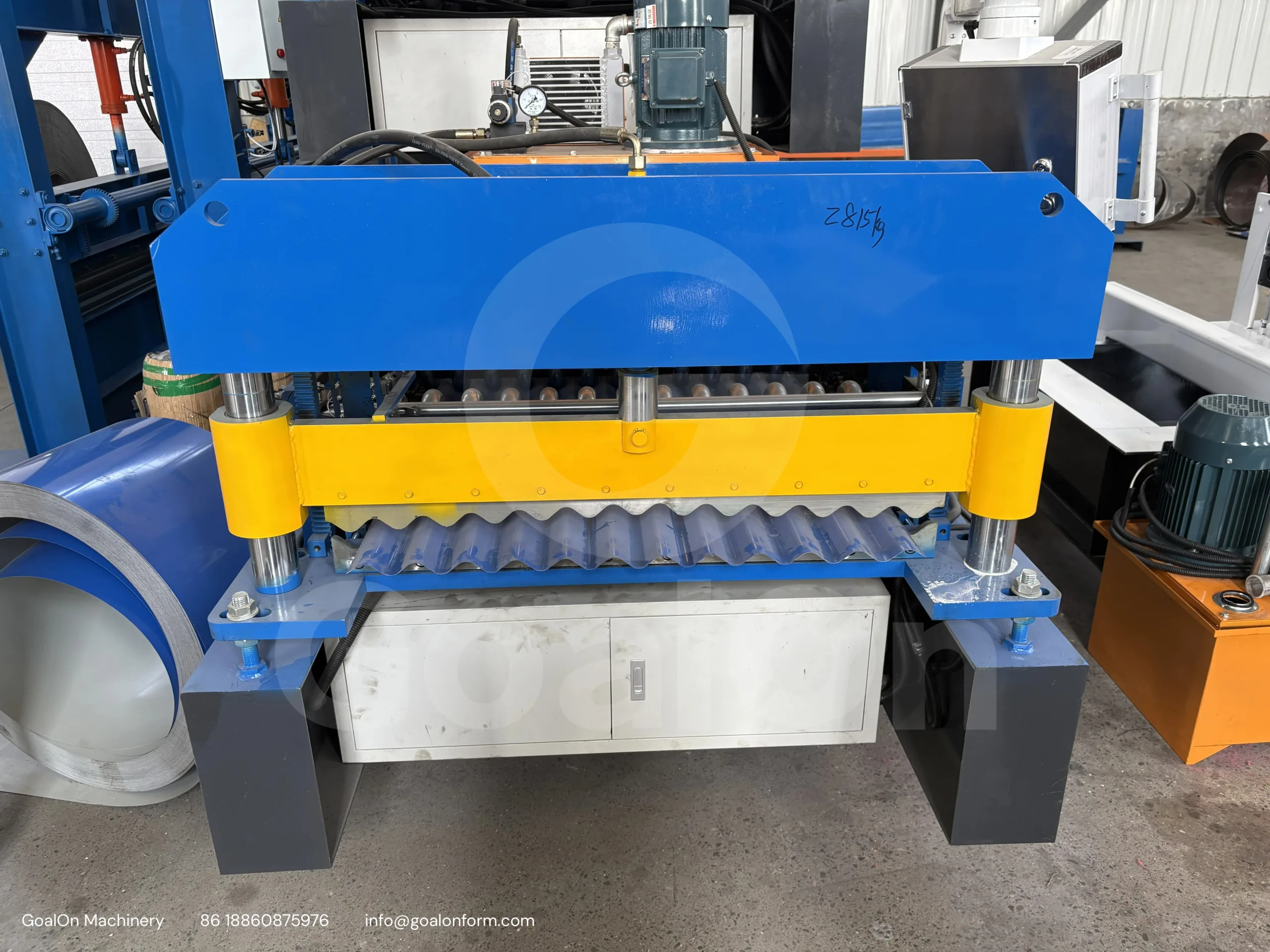
Corrugated sheets are also produced through continuous roll forming, but their curved geometry requires a different roller design.
The rollers gradually create the repeated wave pattern. Each forming station introduces a controlled amount of deformation until the required wave shape is achieved.
Important design factors include:
- Wave pitch.
- Wave height.
- Wave radius.
- Material thickness.
- Roller surface finish.
- Forming pass distribution.
Smooth material flow is especially important because an incorrect forming sequence may cause uneven waves or surface distortion.
After forming, the sheet is cut to the required length.
Although corrugated profiles may look simple, the roller tooling still needs to match the exact wave dimensions and material specifications.
5. Why Do Different Roof Profiles Require Different Roll Forming Machines?
A common misunderstanding among machine buyers is that one standard Roofing Sheet Machine can produce every type of metal roofing profile.
In reality, the machine tooling and forming process must match the required product geometry.
5.1 Roller Design and Profile Geometry
The roller system determines how the flat metal strip changes shape through successive forming stations.
For trapezoidal panels, the rollers must gradually create straight ribs, flat tops, and angled side walls.
For corrugated sheets, the roller contours must produce smooth and consistent curved waves.
For step tile panels, the production system must also account for the transverse tile pattern and the pressing operation where required.
These differences mean that the roller profiles cannot simply be exchanged without considering the complete forming process.
A dedicated roller set is normally required for each different profile.
5.2 Forming Stations and Material Deformation
The number of forming stations depends on the profile geometry, material properties, and forming requirements.
A simple profile may need fewer forming stages, while a more complex profile may require additional stations to distribute deformation gradually.
However, more stations do not automatically guarantee better quality.
Engineers must consider the complete forming sequence, including bend angles, material flow, roller clearance, and the risk of deformation.
Incorrect pass design may cause:
- Edge waves.
- Twisting or bending.
- Uneven rib heights.
- Surface scratches.
- Excessive material stress.
The objective is to achieve a stable forming process with consistent product dimensions.
5.3 Cutting and Production Line Configuration
The cutting system also needs to match the product profile.
A standard hydraulic cutter may be suitable for many trapezoidal and corrugated panels. Step tile panels may require specially designed cutting dies to match their formed cross-section.
The production speed, cutting cycle, panel length, and required output should all be considered when selecting the cutting method.
Other equipment, such as automatic stacking systems, may also be added according to production requirements.
The correct configuration should be determined by the complete manufacturing process, not simply by the machine’s advertised speed.
6. How to Choose the Right Metal Roofing Sheet for Your Project
When choosing between step tile, trapezoidal, and corrugated roofing sheets, buyers should consider more than appearance.
The following factors are important:
1. Building type: Residential projects may prioritize appearance, while industrial buildings may focus more on structural requirements and installation efficiency.
2. Roof design: Roof slope, span, support spacing, and drainage requirements influence profile selection.
3. Local climate: Wind pressure, rainfall, snow loads, and corrosion conditions must be considered.
4. Material specifications: Steel thickness, yield strength, and coating type affect the product’s performance and service life.
5. Installation requirements: Effective cover width, side laps, end laps, and fastening methods influence installation efficiency and water resistance.
6. Project budget: Compare material costs, production costs, transportation, installation, and maintenance rather than looking at the price per sheet alone.
The final choice should follow the building design, applicable standards, and the manufacturer’s tested roofing system.
7. What Should You Consider When Buying a Roofing Sheet Machine?
If you plan to manufacture different types of Metal Roofing Sheets, selecting the right equipment is just as important as choosing the product profile.
Before requesting a quotation, prepare the following information:
- Complete profile drawings with dimensions.
- Material type, such as galvanized steel or pre-painted steel.
- Minimum and maximum material thickness.
- Coil width and material strength.
- Required finished panel lengths.
- Target production speed and output.
- Cutting and stacking requirements.
- Factory power supply and local electrical standards.
A professional machine manufacturer should evaluate the product drawings before recommending a machine configuration.
At Goalon Machinery, we understand that different roofing profiles require different engineering solutions. Roller tooling, forming stations, pressing structures, and cutting systems should be selected according to the actual product requirements.
Our team focuses on customized roll forming equipment for different metal profile applications. We can evaluate your drawings and material specifications to help determine a suitable production line.
8. Conclusion: Match the Roofing Profile with the Right Production Solution
Step tile, trapezoidal, and corrugated roofing sheets each have their own structural characteristics, appearance, and applications.
Step tile is a popular choice for decorative residential roofing. Trapezoidal panels are widely used in industrial and commercial construction, while corrugated sheets remain a practical option for agricultural and general-purpose buildings.
Their manufacturing processes also differ. Roller geometry, forming sequences, pressing operations, and cutting systems must all match the required profile.
If you are planning to manufacture Metal Roofing Sheets, start by confirming the product drawing, material specifications, and target production capacity.
Contact Goalon Machinery to discuss your roofing sheet production requirements. Send us your profile drawings and material details. Our engineering team can help evaluate the suitable Tile Roll Forming Machine or Roofing Sheet Machine for your project.