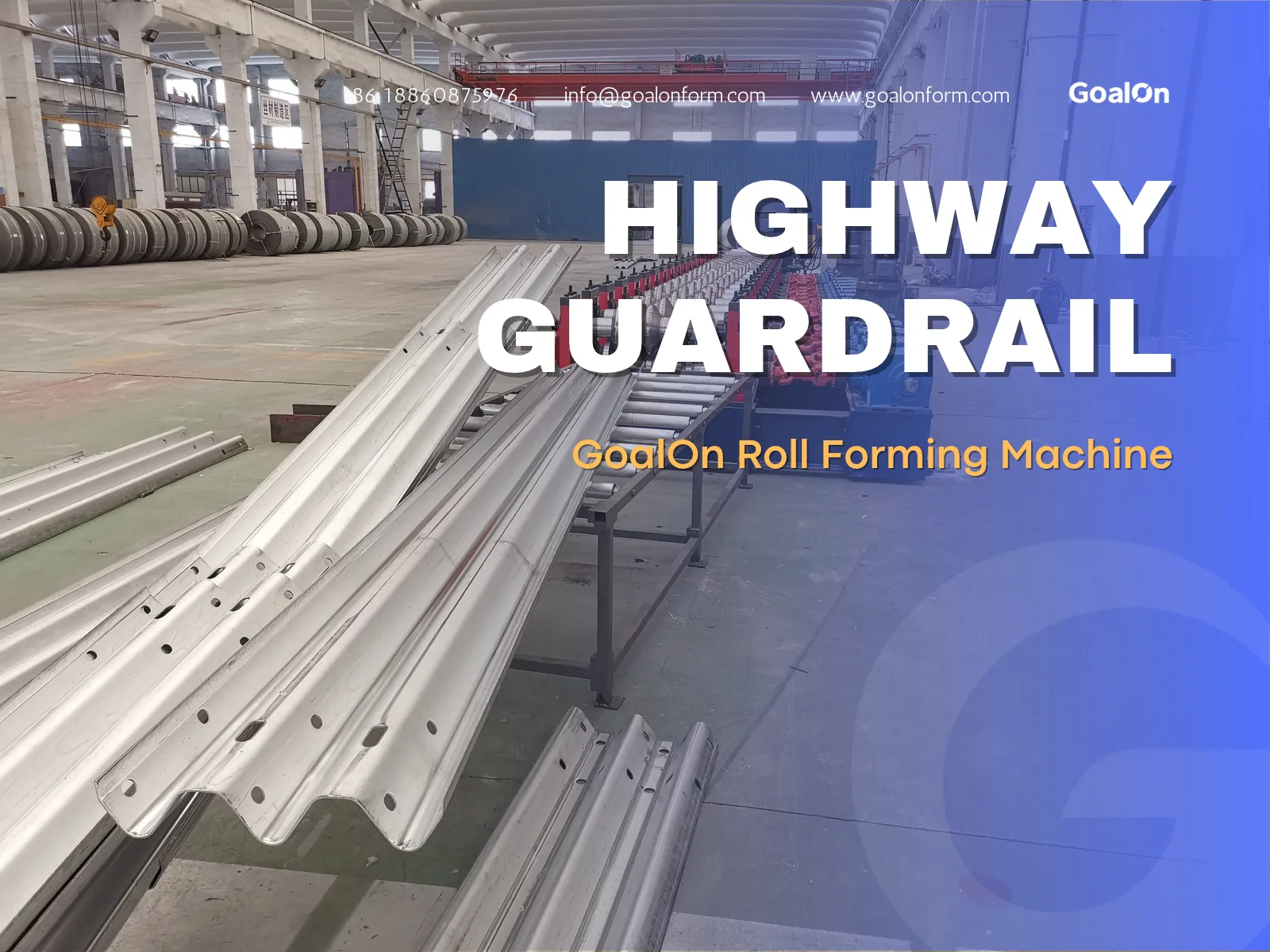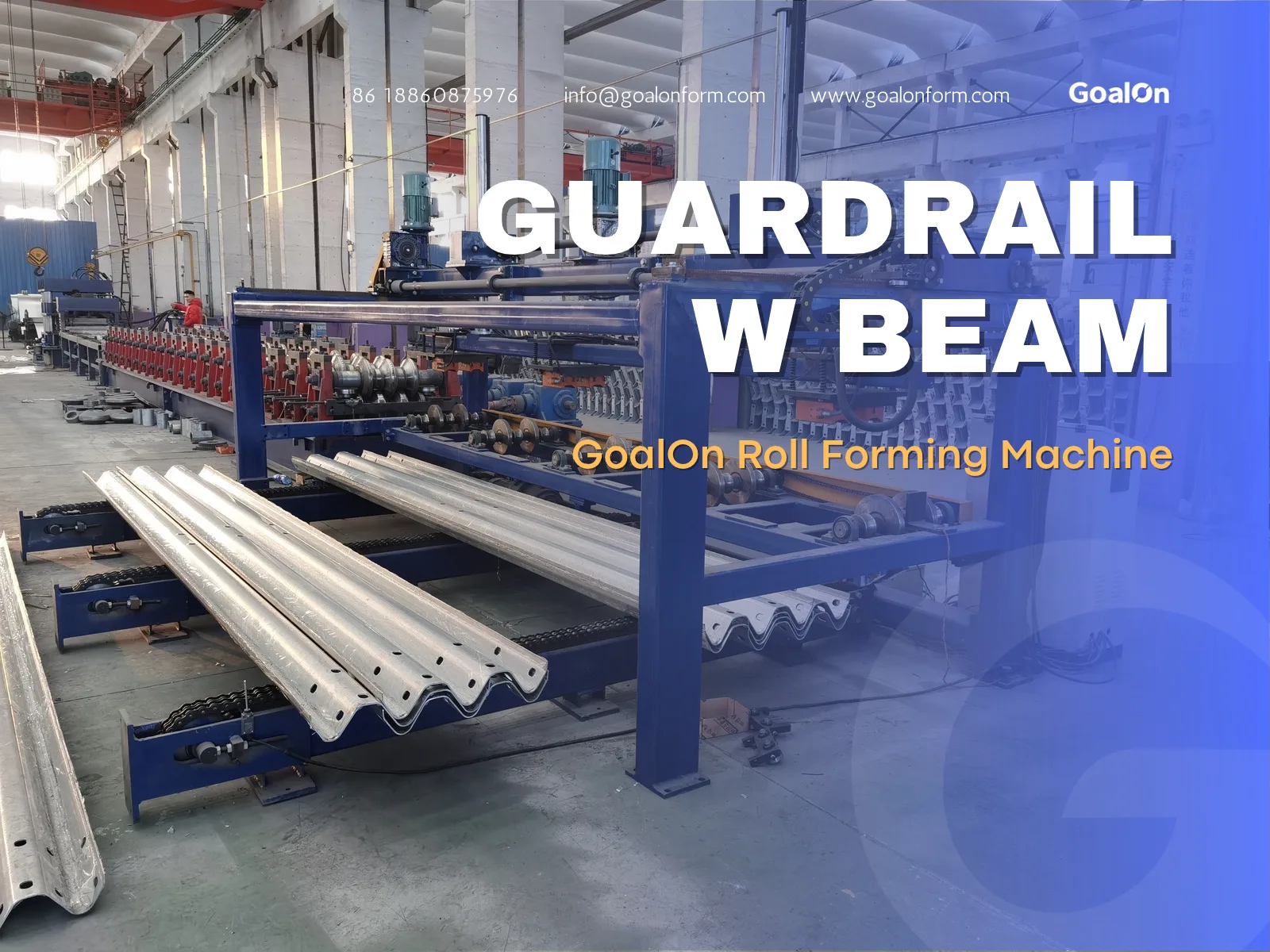
W beam and thrie beam guardrails are two widely used profiles in highway safety barrier systems. Both are made from formed steel and designed to help redirect vehicles that leave the roadway. However, their cross-sections, structural properties, applications, and manufacturing requirements are different.
For road guard rail manufacturers, choosing between these two profiles is not just a product decision. It also affects steel consumption, punching patterns, roll tooling, machine configuration, and production costs.
So, what are the main differences between W beam and thrie beam guardrails? Can one guardrail roll forming machine produce both profiles? And what should manufacturers consider when selecting production equipment?
In this guide, we compare their designs, applications, manufacturing processes, and machine requirements to help buyers make informed decisions.
1. Understanding the Two Main Highway Guardrail Types
Before comparing their manufacturing requirements, let’s look at the basic structure of each profile.
What Is a W Beam Guardrail?
A W beam guardrail is a corrugated steel rail with two main longitudinal waves. Its cross-section resembles the letter W, which gives it its name.
It is widely used in roadside and median barrier systems. The corrugated shape provides structural depth while allowing the rail to deform under impact.
Common features include:
- Two main corrugations across the cross-section.
- A relatively compact profile.
- Bolt holes or slots for panel connections and post installation.
- Compatibility with different post, spacer, and terminal configurations.
W beam guardrails are commonly manufactured from galvanized steel. Their exact dimensions, material properties, and hole patterns depend on the applicable standard and project drawings.
What Is a Thrie Beam Guardrail?
A thrie beam guardrail has three main longitudinal corrugations. Compared with a W beam, it has an additional central wave and a different cross-sectional geometry.
The deeper profile provides different sectional properties and is commonly specified in barrier systems that require a thrie beam configuration.
Its main characteristics include:
- Three main corrugations.
- A deeper and wider developed profile.
- Different bending geometry and forming requirements.
- Specific connection and installation details.
Thrie beam guardrails are often used in bridge approaches, median barriers, and other locations where the approved barrier design specifies this profile.
However, the actual application must follow the tested barrier system and local road authority requirements.

2. W Beam vs. Thrie Beam: Structural Differences
The most visible difference between the two highway guardrail types is their cross-section. However, this difference also affects their dimensions, material requirements, sectional properties, and manufacturing methods.
Number of Corrugations and Profile Geometry
A W beam has two main waves, while a thrie beam has three.
The additional corrugation changes the overall profile geometry. It also affects the developed strip width, bending sequence, and roller tooling design.
| Comparison | W Beam Guardrail | Thrie Beam Guardrail |
|---|---|---|
| Main corrugations | Two | Three |
| Cross-section | W-shaped | Three-wave corrugated profile |
| Profile depth | Depends on standard and drawing | Generally deeper |
| Developed strip width | Typically narrower | Typically wider |
| Forming geometry | Two-wave forming sequence | Three-wave forming sequence |
| Roller tooling | W-beam specific | Thrie-beam specific |
The actual dimensions must be taken from the approved product drawing. Different national standards may specify different profile dimensions and tolerances.
Material Thickness and Cross-Section Properties
Both profiles can be manufactured using structural steel with specified mechanical properties.
Material selection depends on the relevant standard, project requirements, and approved barrier design.
Important parameters include:
- Base metal thickness.
- Yield strength.
- Tensile strength.
- Elongation.
- Zinc coating requirements.
The additional corrugation of a thrie beam changes its cross-sectional area and structural properties.
For example, the USDA Forest Products Laboratory’s Wood Handbook reference material includes section property comparisons showing that, at the same listed uncoated thickness, the Thrie-beam sections have a larger cross-sectional area and section modulus than the corresponding W-beam sections.
This is an important engineering distinction. However, section modulus alone does not determine the crash performance of a complete roadside barrier system.
Weight and Material Consumption
Because a thrie beam generally uses a wider developed strip, its steel consumption per unit length is often higher than that of a comparable W beam made from the same thickness of steel.
This affects several production and purchasing considerations:
- Raw material cost.
- Coil width and weight requirements.
- Decoiler capacity.
- Forming load and motor selection.
- Finished panel weight.
- Transportation and storage costs.
Manufacturers should calculate material consumption using the actual developed profile width, steel thickness, density, and finished panel length.
A simple estimate is:
Steel weight (kg) = Developed strip width (m) × Thickness (mm) × Length (m) × 7.85
This formula estimates the uncoated steel weight. It does not include additional allowances for coating, scrap, or production losses.
For a manufacturer producing both profiles, material planning should be based on separate specifications rather than using one common coil width.
3. W Beam and Thrie Beam Guardrail Applications
The right guardrail profile depends on the road layout, traffic conditions, roadside hazards, design requirements, and approved safety system.
A wider or deeper profile does not automatically make a barrier suitable for every high-risk location.
Typical W Beam Applications
W beam guardrails are widely used in conventional roadside and median barrier systems.
Typical applications include:
- Highway roadside protection.
- Rural roads.
- Road curves and embankments.
- Median barrier systems.
- Roadside areas near fixed hazards.
Their established design and common use make W beam systems a practical choice for many highway infrastructure projects.
Typical Thrie Beam Applications
Thrie beam guardrails are specified in certain barrier systems where their deeper three-wave section is required.
Common applications include:
- Bridge approach protection.
- Selected median barrier systems.
- Transitions between different barrier configurations.
- Roadside locations where the approved design specifies thrie beam.
The profile may also be used as part of a larger barrier arrangement with special posts, spacers, transitions, or connections.
Important engineering point: The selection of W beam or thrie beam must follow the complete tested system design. Factors such as post spacing, post strength, rail height, soil conditions, end terminals, and installation details all influence barrier performance.
For projects in the United States, relevant references may include AASHTO specifications and the FHWA guidance for roadside safety hardware. Other markets may use EN 1317 or their own national standards.
4. W Beam vs. Thrie Beam Manufacturing Process
Although both products are made through cold roll forming, their manufacturing processes require different tooling and production settings.
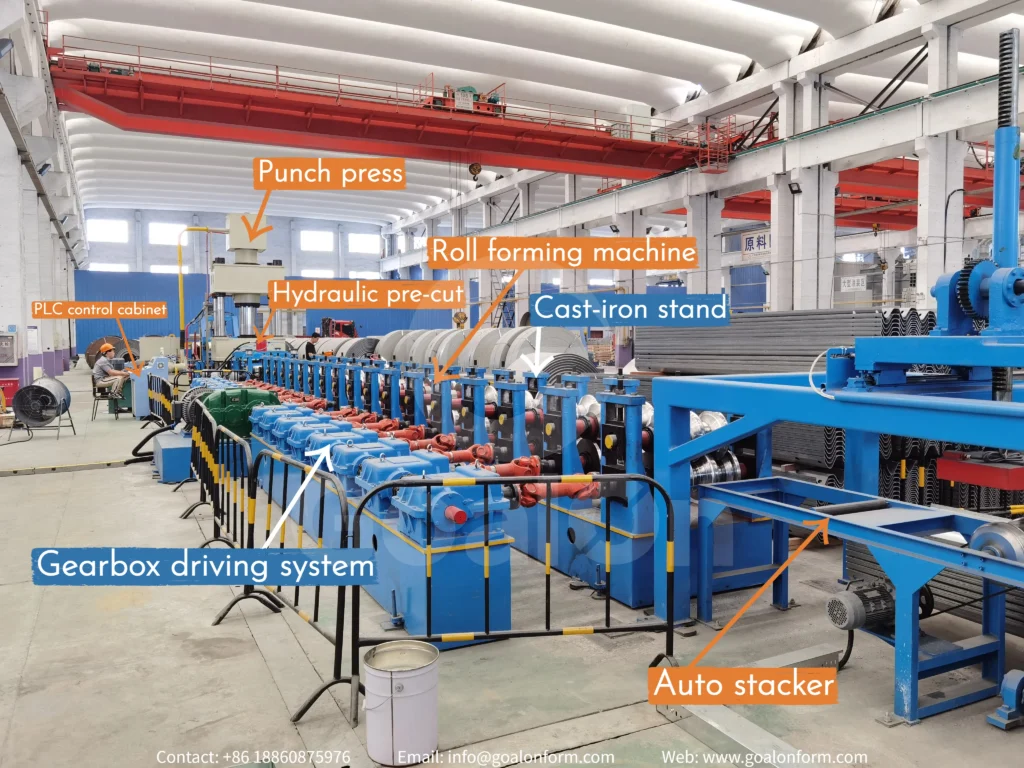
The general production sequence is similar:
Steel coil preparation → Leveling → Punching → Roll forming → Cutting → Galvanizing or coating verification → Quality inspection.
However, the details of each operation depend on the target profile.
Steel Coil Preparation and Punching
The first step is selecting steel coils that meet the required material grade, thickness, and width.
The coil enters the production line through a decoiler and leveling system.
Punching can be arranged before or after roll forming.
For pre-punching, the steel strip is flat when it enters the punching station. This makes die access relatively straightforward.
However, the hole positions must account for material movement during subsequent forming.
For post-punching, the holes are created after the profile has been formed. The punching dies must match the finished cross-section and provide suitable support.
W beam and thrie beam profiles may also have different bolt hole patterns. The die layout must therefore be designed according to the corresponding product drawing.
Roll Forming and Profile Development
Roll forming is the most important stage that distinguishes the two products from a machine design perspective.
For W beam, the rollers gradually create two main corrugations.
For thrie beam, the roller tooling must form three corrugations and control a different distribution of deformation across the wider section.
The forming sequence should be designed to avoid:
- Excessive deformation in a single station.
- Uneven corrugation heights.
- Twisting along the profile.
- Edge waves and surface marks.
- Dimensional deviations caused by springback.
The forming stations must work together to produce a consistent cross-section along the full panel length.
Cutting and Surface Protection
After roll forming, the continuous profile is cut to the specified panel length.
The cutting system must match the product shape and material thickness. A properly designed cutting die helps prevent crushing or deformation around the cut area.
For corrosion protection, manufacturers may use pre-galvanized steel or galvanize the finished components after fabrication.
The selected method must comply with the applicable coating specification. Cut edges and punched areas should also be considered when evaluating corrosion protection.
5. Guardrail Roll Forming Machine: Different Equipment Requirements
A W beam and a thrie beam may look similar in their manufacturing purpose, but they require different forming designs.
A professional guardrail roll forming machine should be developed around the target profile drawing rather than using a general machine configuration for every product.
Roller Design and Forming Stations
The roller design is one of the most important differences.
W beam tooling is designed to create two main waves. Thrie beam tooling must create three waves with a different cross-sectional shape.
The additional corrugation changes the bending sequence and roller contours.
The engineering team needs to consider:
- Profile width and depth.
- Bend radii and angles.
- Steel thickness and strength.
- Material springback.
- Forming load.
- Required dimensional tolerances.
The number of forming stations should be determined through the forming design.
A more complex profile may require a different number or arrangement of stations, but adding more stations does not automatically guarantee better product quality.
Shaft Strength and Machine Structure
Thrie beam production may involve a wider strip and different forming loads.
The machine structure, shaft dimensions, bearings, and drive system must be checked against the actual production requirements.
Important machine components include:
Machine frame: Provides support for the forming stands and maintains alignment under load.
Forming shafts: Transmit torque and support the rollers. Their diameter and rigidity influence forming stability.
Roller material: Must provide suitable hardness, wear resistance, and dimensional stability.
Transmission system: Must deliver stable power to the forming stations.
A machine designed for a lighter profile should not automatically be assumed suitable for a heavier or wider thrie beam specification.
Punching, Cutting and Automation
Both profiles may require different punching dies and cutting tools.
The production line should also consider:
- Hydraulic punching capacity.
- Hole positioning accuracy.
- Punching cycle time.
- Hydraulic cutting capacity.
- PLC control and encoder feedback.
- Automatic feeding and stacking requirements.
The line speed should be evaluated together with punching and cutting cycles. A high forming speed does not necessarily mean high finished-panel output.
6. Can One Guardrail Roll Forming Machine Produce Both Profiles?
This is a common question among manufacturers planning to produce different highway guardrail types.
Yes, it may be possible, but it depends on the machine’s original design.
There are two main approaches.
Option 1: One Machine with Interchangeable Tooling
A machine can be engineered to support both W beam and thrie beam production.
This may involve:
- Separate roller tooling sets.
- Different roller positioning.
- Adjustable or interchangeable guides.
- Dedicated punching dies.
- Different cutting tools.
- Suitable adjustments to the control system.
The advantage is that one machine platform can support different product orders.
However, tooling replacement and machine adjustment take time. The frame, shafts, drive system, and available working space must be designed for both profiles from the beginning.
Option 2: Dedicated Production Lines
Manufacturers with stable, high-volume orders may prefer separate W beam and thrie beam production lines.
Advantages include:
- Less downtime caused by tooling changes.
- Dedicated machine settings.
- More stable production planning.
- Reduced risk of setup errors.
- Easier scheduling for large orders.
| Factor | One Machine with Multiple Tooling Sets | Two Dedicated Lines |
|---|---|---|
| Initial investment | Potentially lower | Higher |
| Tooling change | Required | Usually not required |
| Production flexibility | Higher | Lower between product types |
| Changeover downtime | Higher | Lower |
| Large-volume production | Depends on order mix | Often more suitable |
| Floor space | Usually less | Usually more |
The best option depends on the customer’s order volume, product mix, available factory space, and investment budget.
7. How to Choose the Right Guardrail Production Solution
Before purchasing a guardrail roll forming machine, buyers should prepare the technical information required for equipment design.
Here are the key points to confirm.
1. Target guardrail profile
Confirm whether you need W beam, thrie beam, or both. Provide the cross-section drawing and finished dimensions.
2. Material specifications
Specify steel grade, thickness, yield strength, coil width, and coating requirements.
3. Punching pattern
Provide the hole diameter, slot dimensions, hole spacing, and their positions relative to the finished panel.
4. Production capacity
Define the required output per shift or per day. The supplier should evaluate forming speed together with punching, cutting, and handling cycles.
5. Machine configuration
Review the forming stations, shaft diameter, roller material, transmission system, punching equipment, cutting system, and automation level.
6. Installation and technical support
Confirm commissioning arrangements, operator training, spare parts, maintenance instructions, and after-sales support.
A reliable supplier should explain why each machine component is selected and how the proposed configuration matches your product specifications.
8. Frequently Asked Questions About W Beam and Thrie Beam Guardrails
Is Thrie Beam stronger than W Beam?
Thrie beam has a different cross-section and generally higher sectional properties than a comparable W beam. However, complete barrier performance depends on the entire tested system, including posts, connections, installation, and other components. The profile alone cannot determine crash performance.
Can a W beam roll forming machine produce Thrie beam?
Not necessarily. Thrie beam requires different roller contours and a different forming sequence. A machine can produce both only if its frame, shafts, drive system, tooling arrangement, and control configuration are designed for both profiles.
Are W beam and Thrie beam made from the same steel?
They can use similar steel grades and material thicknesses, depending on the applicable standard. However, their required coil widths, developed profile dimensions, and material consumption are different.
Which guardrail profile is more suitable for highway projects?
There is no universal answer. The choice depends on the approved roadside barrier design, road conditions, project specifications, and required safety performance.
9. Customized Guardrail Roll Forming Solutions from Goalon Machinery
W beam and thrie beam guardrails share the same basic cold roll forming principle, but their structural designs create different manufacturing requirements.
For manufacturers, choosing the right equipment means more than comparing machine prices or advertised production speeds. Roller design, machine rigidity, punching accuracy, cutting performance, and production capacity all need to match the target product.
At Goalon Machinery, we provide customized cold roll forming machine solutions based on customer drawings and production requirements.
Whether you are planning to manufacture W beam guardrails, thrie beam guardrails, or both, our engineering team can evaluate your profile dimensions, steel specifications, hole patterns, and production targets before recommending a machine configuration.
Planning to invest in a W beam and thrie beam roll forming machine?
Send us your product drawings and material specifications. We will help you evaluate the suitable tooling design, machine configuration, and production solution for your business.
Goalon Machinery — Forming Ahead, Building Beyond.