Metal roof tiles are widely used in residential, commercial, and industrial roofing projects. They combine the appearance of traditional roof tiles with the strength and production efficiency of formed steel sheets. However, producing consistent step tile profiles requires more than a standard roll forming machine. The roller design, forming sequence, pressing system, cutting accuracy, and raw material quality all affect the final product.
A well-designed Step Tile Roll Forming Machine gradually forms metal coils into roofing panels with consistent dimensions and a uniform step pattern. In this guide, we explain how the production process works, what matters in roller design, and how manufacturers can maintain the quality of finished Metal Roof Tiles.
1. What Is a Step Tile Roll Forming Machine?
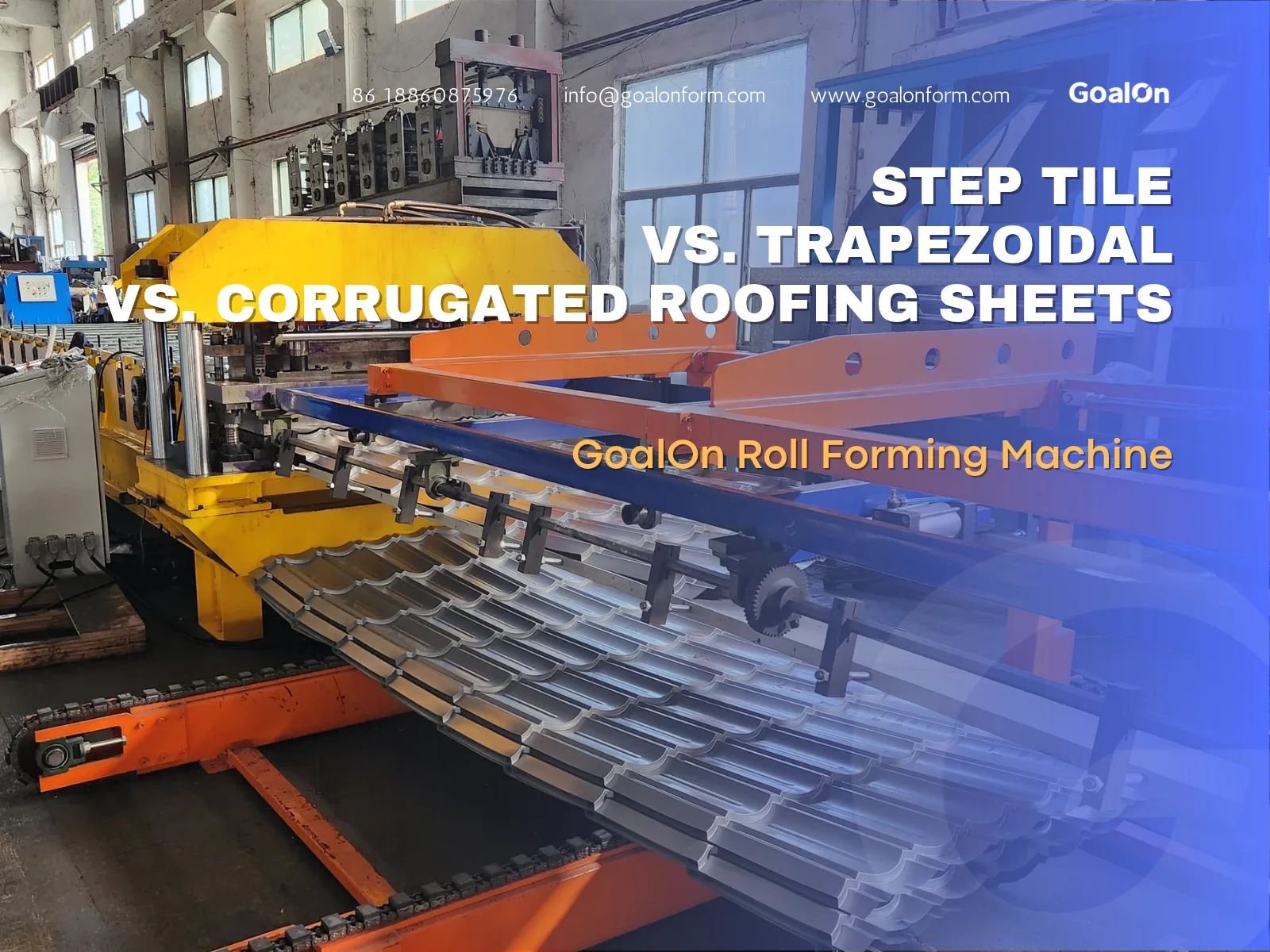
A Step Tile Roll Forming Machine is a specialized production line that processes metal coils into roofing sheets with a stepped or tiled appearance. Instead of producing a flat or continuously ribbed panel, the machine creates a series of raised and recessed sections across the sheet.
These sections give the finished roof panel a tile-like appearance. They also create a recognizable profile that is popular in residential roofing and other architectural applications.
The machine usually processes galvanized steel, pre-painted steel, or other suitable coated metal materials. The exact material and thickness depend on the profile drawing, customer requirements, and machine design.
A typical step tile production line includes:
- Decoiler: Holds and releases the metal coil.
- Leveling unit: Reduces coil curvature and prepares the material for forming.
- Feeding system: Controls material movement and feeding length.
- Roll forming unit: Gradually forms the required longitudinal profile.
- Hydraulic pressing system: Creates the required step pattern when the profile design requires transverse pressing.
- Cutting system: Cuts panels to the required length.
- Run-out table or automatic stacker: Supports finished panels after cutting.
An important point: Different step tile profiles may require different forming and pressing arrangements. Some designs use a dedicated hydraulic pressing unit to create the tile steps, while others use a different forming arrangement. The final machine configuration should follow the actual profile drawing rather than a standard machine layout.

2. How Does a Step Tile Roll Forming Machine Work?
Understanding the step tile roofing machine working process helps buyers evaluate the equipment more accurately. Each production stage has a different function. Poor coordination between these stages can affect panel dimensions, surface appearance, and production stability.
2.1 Coil Feeding and Material Preparation
The process starts with a metal coil mounted on the decoiler. The decoiler releases the material at a controlled speed and feeds it into the production line.
Before forming, the metal strip may pass through a leveling unit. Steel coils naturally retain some curvature because of winding and storage. If this curvature is not properly controlled, it can affect the feeding condition and the flatness of the finished panels.
The feeding system then guides the material into the forming section. For machines with a separate pressing operation, the feeding length and positioning must also match the required tile pattern.
Several factors need attention at this stage:
- Coil width must match the machine design.
- Material thickness must remain within the specified range.
- Feeding rollers should maintain stable contact with the sheet.
- The leveling unit must be adjusted according to material properties.
- The feeding system should avoid scratches and unnecessary surface damage.
For pre-painted steel, protecting the coating is especially important. Scratches created during feeding may remain visible on the finished roofing panels.
2.2 Roll Forming and Step Profile Formation
After material preparation, the sheet enters the roll forming section.
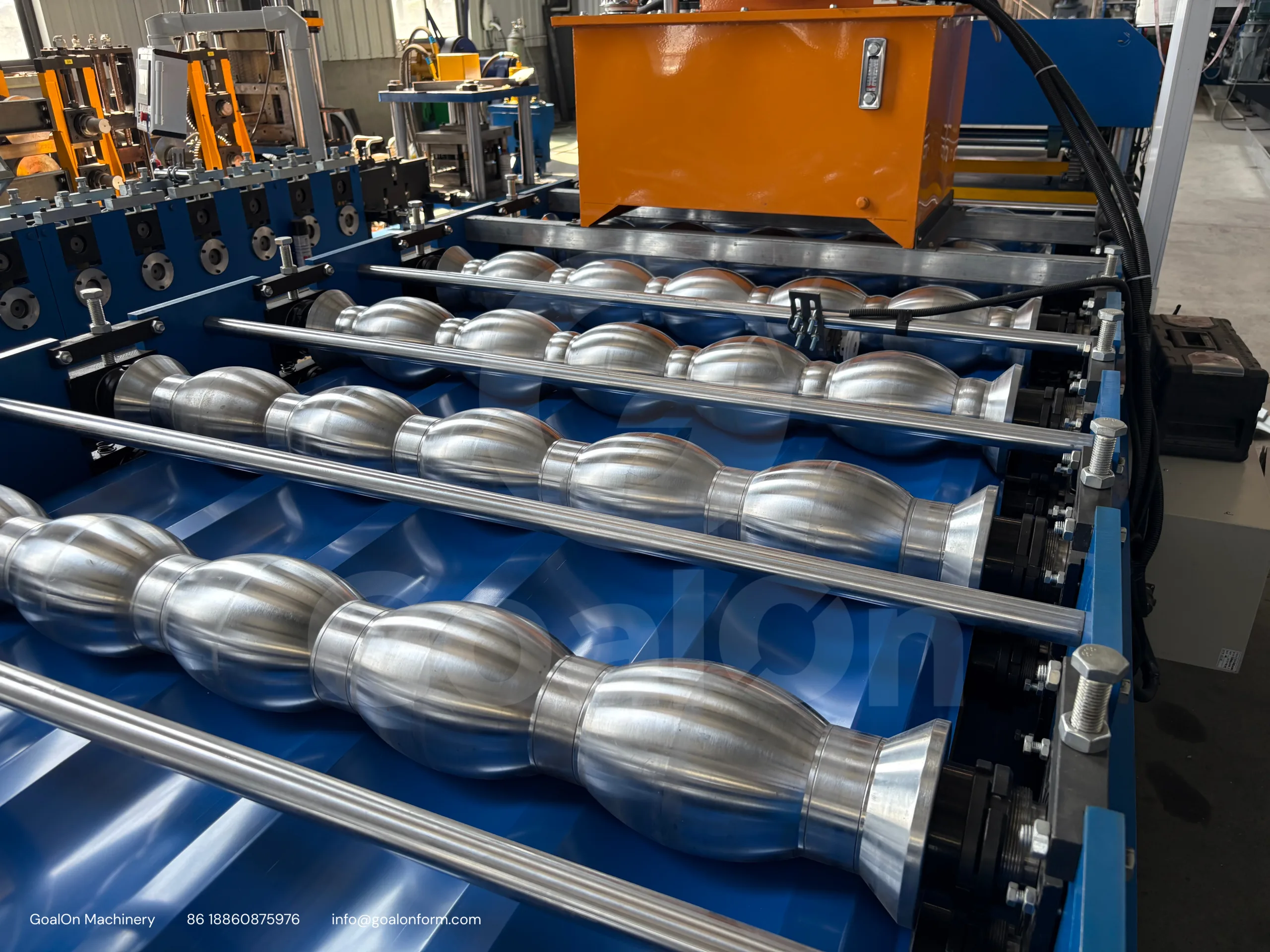
The forming rollers are arranged in multiple stations. Each station introduces a small amount of deformation. As the material passes through successive stations, it gradually reaches the required cross-section.
This gradual process is important because forming the entire profile in one operation would create excessive local deformation and increase the risk of defects.
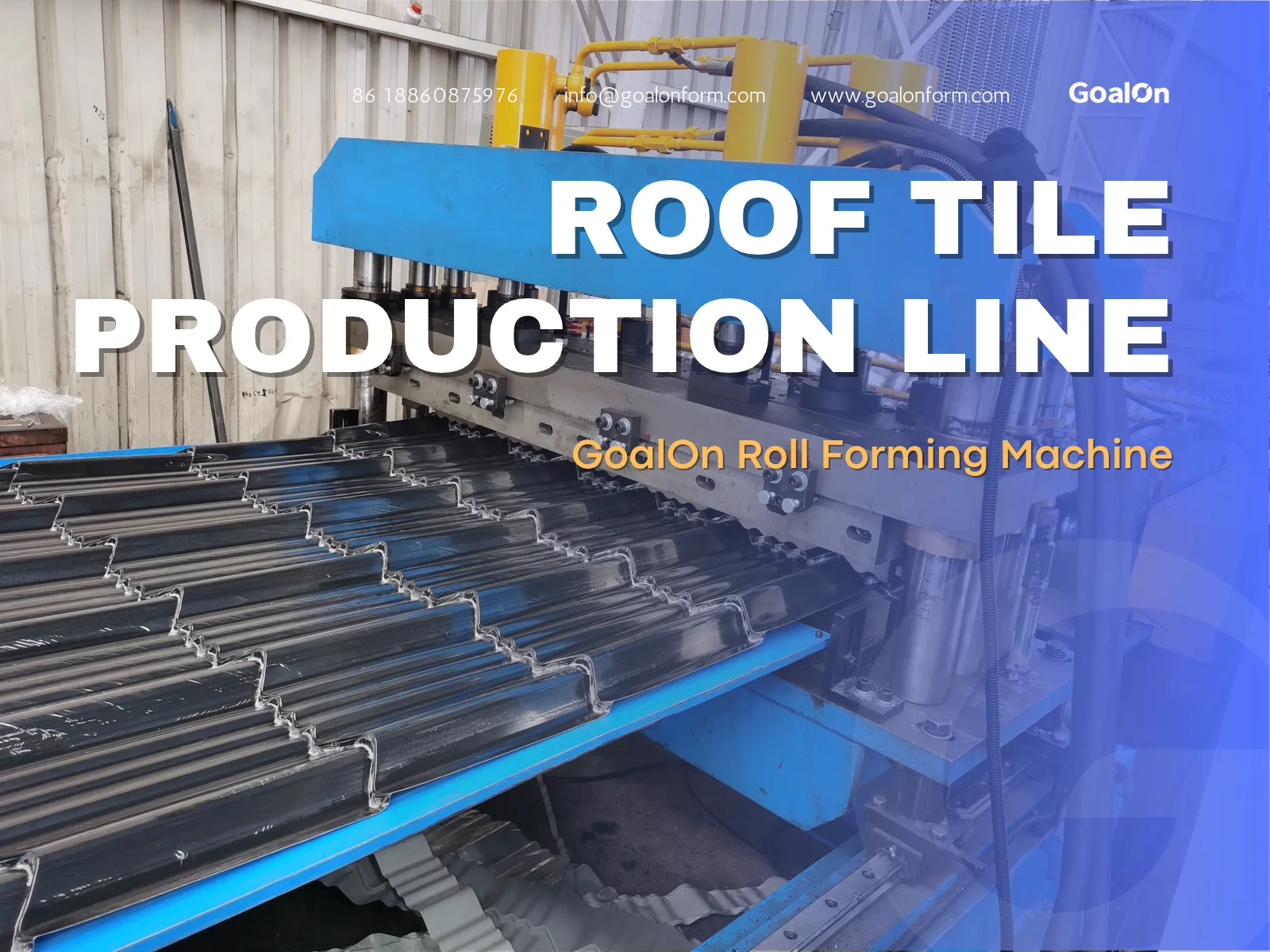
In a step tile production line, the longitudinal profile and the transverse tile pattern must work together. The roll forming section creates the required continuous profile, while the pressing arrangement produces the stepped appearance according to the machine design.
The forming sequence must be carefully coordinated. If the material is pressed before its supporting profile is properly formed, the sheet may deform or develop unwanted marks.
The correct sequence depends on the product drawing, material properties, and production line structure.
2.3 Pressing, Cutting and Finished Panel Handling
The pressing system creates the raised and recessed tile sections. Hydraulic pressing is commonly used when the required step pattern needs a controlled pressing force.
The press must work in coordination with the material feeding system. Incorrect feeding length or pressing position can cause uneven step spacing and inconsistent panel dimensions.
After the required forming and pressing operations, the cutting system separates the finished panel from the continuous material.
The cutting process should provide clean edges without excessive deformation. Once cut, the finished panels move to a run-out table or automatic stacking system.
For manufacturers producing multiple panel lengths, the PLC control system can manage feeding length and production quantity. The exact control functions depend on the machine configuration.
3. Why Roller Design Matters in Metal Roof Tile Production
Roller design is one of the most important factors in a Tile Roll Forming Machine. It directly affects forming accuracy, material flow, surface quality, and machine stability.
A machine may have many forming stations, but a higher station count does not automatically mean better performance. The roller profile and forming sequence must match the product geometry and material characteristics.
3.1 Roller Pass Design and Gradual Forming
A roller pass design describes how the metal profile changes from one forming station to the next.
For step tile profiles, engineers need to consider the following points:
- Profile geometry: The roller design must match the customer’s cross-section drawing.
- Forming sequence: Each station should introduce a controlled amount of deformation.
- Material flow: The sheet should move smoothly without unnecessary stretching or compression.
- Edge forming: Both sides should remain consistent throughout the forming process.
- Clearance: Roller gaps must allow the material to pass without excessive pressure or unwanted movement.
Poorly designed roller passes may cause edge waves, surface marks, twisting, or dimensional deviations.
The engineering team should evaluate the complete profile rather than design each roller station independently. The forming process must be continuous and coordinated from the first station to the last.
3.2 Roller Material, Hardness and Surface Finish
Roller material is another important consideration. Different materials offer different levels of hardness, wear resistance, and machining performance.
Common choices include 45# steel, 40Cr, and GCr15. The selection depends on the machine design, expected production volume, material characteristics, and required service life.
| Roller material | Main characteristics | Typical consideration |
|---|---|---|
| 45# steel | Good machinability and general mechanical properties | General forming applications |
| 40Cr | Higher strength after suitable heat treatment | Applications requiring improved mechanical performance |
| GCr15 | High hardness and wear resistance after heat treatment | Rollers requiring good wear resistance |
For demanding applications, GCr15 rollers may be heat-treated to approximately HRC 58–62, depending on the design and heat treatment process.
However, hardness alone does not guarantee good roller performance. Surface finish, dimensional accuracy, heat treatment quality, and machining precision also matter.
For pre-painted metal sheets, smooth roller surfaces and properly controlled clearances help reduce coating damage.
4. How to Maintain Accurate Step Tile Dimensions
Dimensional accuracy is essential for metal roofing manufacturers. Finished panels need consistent widths, lengths, step heights, and step spacing. Significant variations may create difficulties during installation and affect the appearance of the completed roof.
Several factors influence forming accuracy.
First, the incoming material must be consistent. Different thicknesses, yield strengths, and coating conditions can change how the metal behaves during forming.
Second, the roller gaps must be properly adjusted. Excessive pressure may cause surface marks or deformation. Insufficient contact may result in unstable forming.
Third, the machine frame and shafts must provide sufficient rigidity. If the machine structure is not stable under forming loads, roller alignment may change during operation.
Fourth, feeding and pressing positions must be synchronized. This is especially important for step tile profiles because the distance between adjacent steps is a key product dimension.
Finally, the machine must be tested using the actual production material. A profile that looks correct in a CAD drawing may behave differently during real production.
Before final acceptance, manufacturers should check several samples from a continuous production run.
| Inspection item | What to check | Why it matters |
|---|---|---|
| Overall width | Finished panel width | Installation compatibility |
| Panel length | Cutting length deviation | Consistent panel dimensions |
| Step height | Height of each raised section | Uniform appearance |
| Step spacing | Distance between adjacent steps | Consistent tile pattern |
| Cross-section | Profile shape and symmetry | Correct roof profile |
| Surface condition | Scratches, dents and coating damage | Appearance and coating protection |
| Edge condition | Burrs and cutting deformation | Safe handling and installation |
A good inspection process should use the customer’s approved profile drawing and agreed tolerances as the reference. There is no single dimensional tolerance that applies to every step tile product.
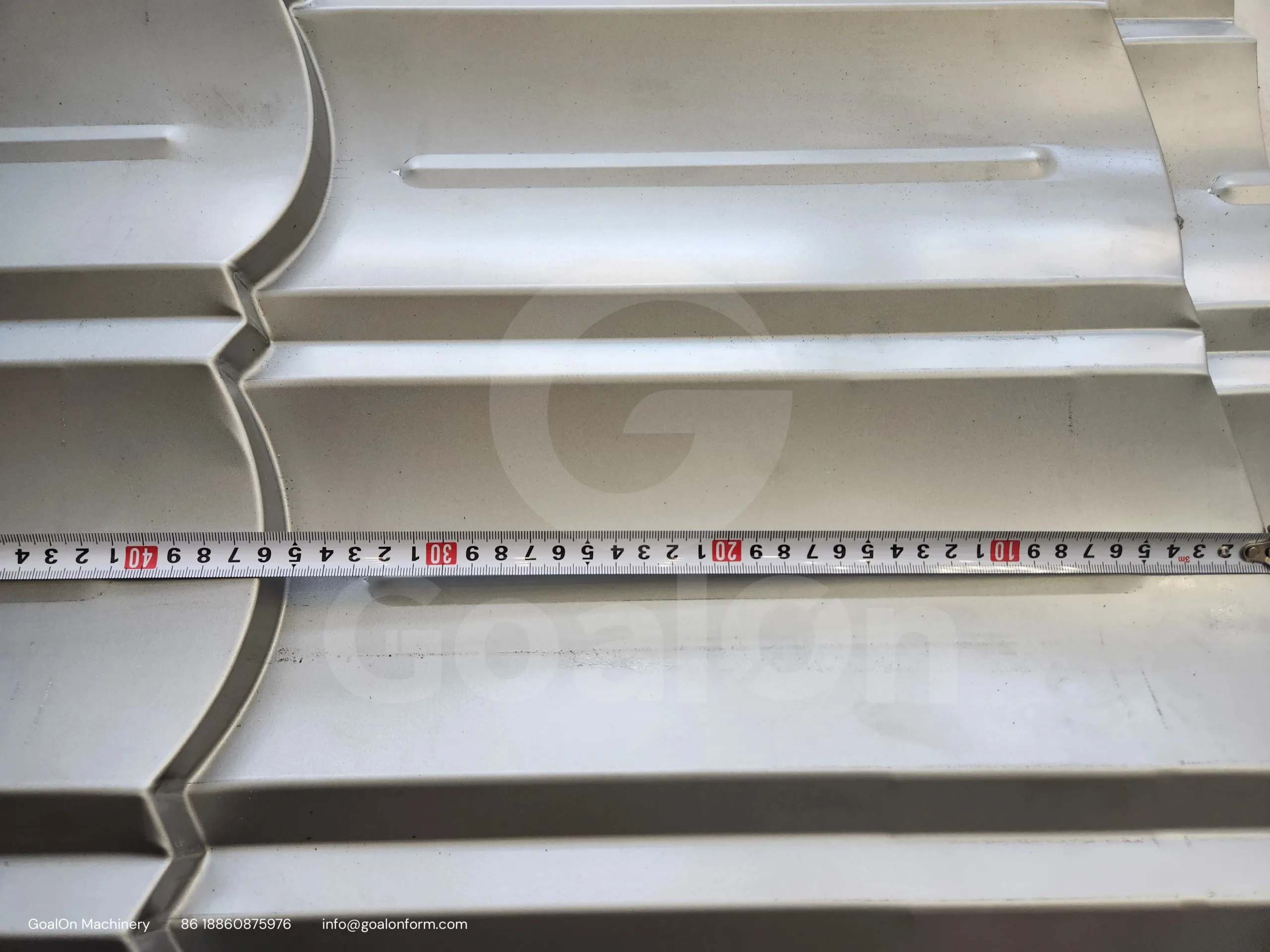
5. Choosing the Right Cutting Method for Roof Tiles
Cutting accuracy is another important part of the metal roof tile production process. The cutting system must match the panel profile, material thickness, production speed, and required panel length.
Two common solutions are fixed hydraulic cutting and flying hydraulic cutting.
| Cutting method | How it works | Main advantages | Considerations |
|---|---|---|---|
| Fixed hydraulic cutting | The material stops before the cutting operation | Straightforward structure and controlled cutting position | The feeding process pauses during cutting |
| Flying hydraulic cutting | The cutting unit moves with the material during cutting | Reduces production interruptions and supports higher output | Requires more complex synchronization and control |
For fixed cutting, the material stops at the target length before the hydraulic cutter operates. This is a practical solution for many standard production lines.
For flying cutting, the cutter follows the moving sheet during the cutting cycle. This reduces the need to stop the entire production process and can improve output efficiency.
However, flying cutting is not automatically the best choice for every project. The panel profile, cutting force, line speed, and machine budget all need consideration.
For step tile products, the cutter must also be compatible with the formed cross-section. A poorly matched cutting die may deform the panel edges or leave an uneven cutting surface.
The cutting system should therefore be designed around the actual finished profile, not selected only by comparing machine speed.
6. Seven Factors That Affect Metal Roof Tile Quality
Even with a well-designed Tile Roll Forming Machine, finished product quality depends on several connected factors.
Here are seven important points manufacturers should consider.
1. Raw Material Thickness and Properties
Material thickness, yield strength, and mechanical properties influence forming resistance and springback. Changes in incoming material may require adjustments to the forming process.
2. Roller Profile Design
The roller profile must match the required cross-section. Incorrect geometry may create uneven ribs, edge waves, or profile deviations.
3. Forming Pass Sequence
The material should be formed gradually. Poor distribution of deformation between stations can create excessive stress in certain areas.
4. Roller Alignment and Clearance
Misaligned rollers may cause the sheet to move sideways or produce inconsistent profiles. Proper adjustment is necessary to maintain stable material flow.
5. Hydraulic Pressing Accuracy
For products with pressed step patterns, the pressing position, stroke, force, and feeding synchronization affect step height and spacing.
6. Cutting Die Design
The cutting die should match the finished profile. Incorrect clearance or die geometry may cause burrs, edge deformation, or inaccurate panel lengths.
7. Machine Adjustment and Maintenance
Roller wear, loose fasteners, poor lubrication, and unstable hydraulic pressure can gradually affect production quality. Regular inspection helps maintain consistent operation.
These factors are interconnected. For example, adjusting roller pressure may not solve an edge wave problem if the actual cause is an incorrect forming sequence or unstable raw material.
A reliable production solution requires identifying the cause of a defect rather than making random adjustments.
7. What Should You Check Before Buying a Step Tile Machine?
Choosing a Step Tile Machine is not simply a matter of comparing prices or the number of roller stations. Buyers should evaluate whether the proposed machine can produce their required roofing profile with stable quality.
Before requesting a quotation, prepare the following information:
- Profile drawing with accurate dimensions.
- Material type, such as galvanized or pre-painted steel.
- Minimum and maximum material thickness.
- Required coil width and material strength, if available.
- Finished panel length and step dimensions.
- Expected production capacity.
- Cutting and stacking requirements.
- Electrical standards and factory conditions.
The profile drawing is particularly important. Two products may both be called step tiles but have different step heights, spacing, cross-sections, and forming requirements.
These differences can affect roller design, pressing structure, cutting dies, and the complete machine configuration.
When evaluating a supplier, ask for more than a basic machine specification sheet. Consider these questions:
- Can the supplier design the roller system according to your actual profile drawing?
- Has the machine been tested with the required material thickness?
- Can the supplier show real production videos and finished product samples?
- Are the pressing and cutting systems designed for your specific profile?
- What inspection procedures are used before shipment?
- What installation guidance, technical support, and warranty are provided?
At Goalon Machinery, we believe that a suitable roll forming solution starts with understanding the customer’s product requirements. Machine structure, roller design, pressing arrangements, and cutting methods should be selected according to the actual application.
A well-matched machine can help manufacturers maintain product consistency, reduce unnecessary material waste, and build a more stable production process.
8. Conclusion: Build a Reliable Metal Roof Tile Production Line
Producing high-quality metal roof tiles requires more than simply passing a steel sheet through a series of rollers. The complete process depends on material preparation, roller pass design, accurate forming, synchronized pressing, and suitable cutting methods.
A properly engineered Step Tile Roll Forming Machine should be designed around the finished profile, material specifications, and production requirements. These factors determine whether the machine can deliver consistent dimensions, clean edges, and a uniform tile appearance.
If you are planning to manufacture step tile roofing sheets, start with your product drawing and material specifications. The right equipment configuration should be developed around these requirements.
Contact Goalon Machinery to discuss your step tile production requirements. Share your profile drawing, material thickness, and expected production capacity. Our team can help evaluate a suitable roller forming, pressing, and cutting solution for your project.